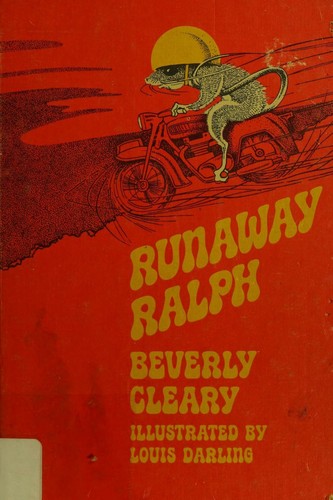
Runaway Ralph (1970) Parents Guide: Is the book OK for kids?
Age Rating, Sex, Violence & Language
Runaway Ralph is the second in a children's novel trilogy written by Beverly Cleary. First published in 1970, it is the last book by Cleary that Louis Darling illustrated before his death. The book features the titular character, Ralph S. Mouse, a house mouse that can talk to humans, and goes on adventures on his miniature motorcycle. The book was given the Nene Award by the Hawaii Library Association in 1972.
Middle Grade • 1970 • 175 pages • Lexile 730L (roughly grades 2–3 reading difficulty)
Runaway Ralph is a classic middle-grade adventure that follows a mouse seeking independence from his pestering family. The story deals with themes of responsibility, the consequences of running away, and the development of empathy between humans and animals. Parents should note that while the book is very mild, it includes scenes of animal peril (predators and traps) and a plot line involving a child falsely accused of theft. It is… Sign up for the full guide
Is Runaway Ralph appropriate for kids?
Runaway Ralph is a classic middle-grade adventure that follows a mouse seeking independence from his pestering family. The story deals with themes of responsibility, the consequences of running away, and the development of empathy between humans and animals. Parents should note… Read more — free account
Content severity in Runaway Ralph
What happens in Runaway Ralph, moment by moment
- p. 12 🔥 Mature Themes 2/10
- p. 28 ⚔ Violence & Gore 3/10
- p. 45 ⚔ Violence & Gore 2/10
Sex and nudity in Runaway Ralph
Sex and nudity are entirely absent from this book. The narrative focuses strictly on Ralph’s adventures and his interactions with human characters at a summer camp, maintaining a wholesome tone appropriate for young readers. There are no romantic subplots or instances of suggestive content. The book maintains a focus on the whimsy of a motorcycle-riding mouse and the simple daily life of a 1970s youth camp. Even references to physical affection are limited to familial bonds or animal-human friendships.
Violence and gore in Runaway Ralph
Minimal and restricted to mild animal peril. Ralph faces threats from a cat, a watchdog, and an owl; he is also kept in a cage against his will, which causes him significant distress. Throughout the journey, Ralph is in constant danger of being stepped on or crushed by human activities, such as a rolling tire or a closing door. At one point, Ralph is trapped in a butterfly net which causes panic, and Catfoot the cat remains a looming, predatory threat for several chapters. These scenes emphasize the vulnerability…
Read more — free accountLanguage in Runaway Ralph
Clean. There is no profanity. Occasional mild insults between children like 'tattletale' or 'thief' are used in the context of the story's conflict. Garf is subjected to peer pressure and verbal bullying from other campers who believe he is dishonest. Words like 'dumb' or 'nuisance' appear occasionally when characters are frustrated. The dialogue is polite and reflective of children's literature from the era, focusing more on the internal thoughts of Ralph than on human dialogue.
Drugs, alcohol, and smoking in Runaway Ralph
There is no use or mention of alcohol, tobacco, or illegal drugs in this story. The plot remains centered on Ralph the mouse and the daily activities of the campers, with no adult-oriented substances appearing in the narrative. The focus is purely on Ralph's survival in the natural world and his interactions with Garf at the summer camp. Characters consume standard camp fare like peanut butter sandwiches, which Ralph occasionally scavenges. No medication or medical substances are used during the course of the…
Read more — free accountMature themes in Runaway Ralph
Independence and consequences are the primary focus as Ralph realizes running away is harder than expected. Integrity is explored through the character Garf, who is wrongly accused of stealing a watch. The book also touches on the loneliness of being an outsider, as seen through Garf's difficulty making friends and Ralph's isolation in a cage. Responsibility is a key takeaway when Ralph learns that true freedom requires managing oneself and respecting others. Ultimately, the story highlights the importance of home…
Read more — free accountFrequently Asked Questions
Is Runaway Ralph appropriate for kids?
Bontent's parent guide suggests Runaway Ralph is best for ages 7+. Runaway Ralph is a classic middle-grade adventure that follows a mouse seeking independence from his pestering family. The story deals with themes of responsibility, the consequences of running away, and the development…
What age rating does Runaway Ralph have?
Books don't carry official age ratings. Runaway Ralph is published for a Middle Grade audience, and Bontent's independent parent guide recommends it for ages 7+.
What reading level is Runaway Ralph?
Runaway Ralph is 175 pages and its reading level is Lexile 730L (roughly grades 2–3 reading difficulty). Bontent recommends it for ages 7+.
What is Runaway Ralph about?
Runaway Ralph is a classic middle-grade adventure that follows a mouse seeking independence from his pestering family. The story deals with themes of responsibility, the consequences of running away, and the development of empathy between humans and animals. Parents should note that while the book is very mild, it…
Is there sex or nudity in Runaway Ralph?
Sex and nudity are entirely absent from this book. The narrative focuses strictly on Ralph’s adventures and his interactions with human characters at a summer camp, maintaining a wholesome tone appropriate for young readers. There are no romantic subplots or…
How violent is Runaway Ralph?
Minimal and restricted to mild animal peril. Ralph faces threats from a cat, a watchdog, and an owl; he is also kept in a cage against his will, which causes him significant distress. Throughout the journey, Ralph is in constant danger of being stepped on or…
Is the language in Runaway Ralph appropriate for kids?
Clean. There is no profanity. Occasional mild insults between children like 'tattletale' or 'thief' are used in the context of the story's conflict. Garf is subjected to peer pressure and verbal bullying from other campers who believe he is dishonest. Words…
Are drugs, alcohol, or smoking depicted in Runaway Ralph?
There is no use or mention of alcohol, tobacco, or illegal drugs in this story. The plot remains centered on Ralph the mouse and the daily activities of the campers, with no adult-oriented substances appearing in the narrative. The focus is purely on Ralph's…
What mature themes appear in Runaway Ralph?
Independence and consequences are the primary focus as Ralph realizes running away is harder than expected. Integrity is explored through the character Garf, who is wrongly accused of stealing a watch. The book also touches on the loneliness of being an…
Where can I read the full Runaway Ralph parent guide?
Create a free Bontent account to unlock page-level notes, filter by your kids' ages, and save titles to your watchlist.
Parents also checked these books for 7-year-olds
Sign up to filter



![Aesop's Fables [Great Illustrated Classics adaptation]](https://covers.openlibrary.org/b/id/9627909-L.jpg)




Books like Runaway Ralph with similar intensity
Sign up to filter




Less intense books for families
Sign up to filter


More classics books with parent guides
- The Dictionary of Lost Words parent guide
- Nine Lives parent guide
- Hana Khan Carries On parent guide
- Charlie the Choo-Choo parent guide
- The Return of the Young Prince parent guide
- The Name of the Wind / The Wise Man's Fear / The Slow Regard of Silent Things (The Kingkiller Chronicle #1-2.5) parent guide
- Clash of star-kings parent guide
- This House Will Feed parent guide
- The Bookshop on Rosemary Lane parent guide
- Told in letters parent guide
- Babel: Or the Necessity of Violence: An Arcane History of the Oxford Translators' Revolution parent guide
- The Titan’s Curse (Percy Jackson and the Olympians, #3) parent guide
Middle Grade books parents are checking
- The Hobbit, or There and Back Again parent guide
- Leopardstar's Honor parent guide
- The Princess Bride Deluxe Limited Edition: S. Morgenstern's Classic Tale of True Love and High Adventure parent guide
- The complete works of the Gawain-poet parent guide
- The Bad Beginning (A Series of Unfortunate Events #1) parent guide
- Harry Potter and the Philosopher's Stone parent guide
- Harry Potter and the Sorcerer's Stone (Harry Potter, #1) parent guide
- The Chronicles of Narnia Set parent guide
- Hilo Book 8 parent guide
- Emily Wilde's Encyclopaedia of Faeries (Emily Wilde, #1) parent guide
More books by Beverly Cleary
- The Mouse and the Motorcycle parent guide
- Ramona Quimby, Age 8 parent guide
- Beezus and Ramona parent guide
- Dear Mr. Henshaw parent guide
- Ramona the Pest parent guide
- Ramona and Her Father parent guide
- Ramona and Her Mother parent guide
- Ramona Forever parent guide
- Henry Huggins parent guide
- Henry and Ribsy parent guide
More books with Bontent parent guides
- Sunrise on the Reaping parent guide
- Black Cake parent guide
- The Dictionary of Lost Words parent guide
- Just For The Cameras parent guide
- Crow parent guide
- Operation Bounce House parent guide
- Hana Khan Carries On parent guide
- Tall Oaks parent guide
- Kingdom of Shadow and Light parent guide
- ¡Hola Papi!: How to Come Out in a Walmart Parking Lot and Other Life Lessons parent guide
- You Did Nothing Wrong parent guide
- The Total Package parent guide
- Moon Witch, Spider King parent guide
- Ghosted: An American Story parent guide
- Clash of star-kings parent guide
- This House Will Feed parent guide