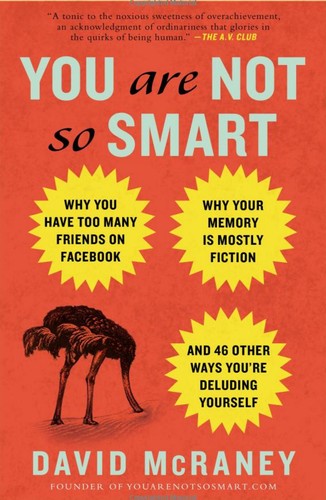
You are not so smart (2011) Parents Guide: Is the book OK for kids?
Age Rating, Sex, Violence & Language
An entertaining illumination of the stupid beliefs that make us feel wise, based on the popular blog of the same name. Whether you’re deciding which smartphone to purchase or which politician to believe, you think you are a rational being whose every decision is based on cool, detached logic. But here’s the truth: You are not so smart. You’re just as deluded as the rest of us—but that’s okay, because being deluded is part of being human. Growing out of David McRaney’s popular blog, You Are Not So Smart reveals that every… Sign up for the full guide
Adult • 2011 • 311 pages • Grade 9-12
This non-fiction psychology book explores common cognitive biases, heuristics, and logical fallacies that shape human behavior. While educational and highly informative, it earns its suggested age due to clinical discussions of disturbing psychological experiments (such as the Milgram experiment or the bystander effect) and occasional adult language used for emphasis. It is best suited for older teens and adults interested in… Sign up for the full guide
Is You are not so smart appropriate for kids?
This non-fiction psychology book explores common cognitive biases, heuristics, and logical fallacies that shape human behavior. While educational and highly informative, it earns its suggested age due to clinical discussions of disturbing psychological experiments (such as the… Read more — free account
Content severity in You are not so smart
What happens in You are not so smart, moment by moment
- p. 1 🔥 Mature Themes 2/10
- p. 12 🔥 Mature Themes 4/10
- p. 28 🔥 Mature Themes 2/10
Sex and nudity in You are not so smart
Sexual content is virtually non-existent throughout this non-fiction work, as the focus remains strictly on cognitive psychology and behavioral science. Some chapters, such as the discussion on the Halo Effect in chapter 24, briefly mention human mating preferences and physical attractiveness in a clinical, non-graphic context. The book explores evolutionary psychology to explain why certain traits are perceived as desirable, but it avoids any descriptive or suggestive scenes. These sections are intended to…
Read more — free accountViolence and gore in You are not so smart
The text contains moderate clinical descriptions of psychological trauma and historical experiments that involve simulated or implied harm. Notable examples include the detailed stabbing and murder of Kitty Genovese in the 'Bystander Effect' chapter and the visualization of the 'Trolley Problem' where readers must choose who to kill. The Milgram Experiment and the Stanford Prison Experiment are also described, detailing how participants were induced to believe they were causing physical pain to others. While these…
Read more — free accountLanguage in You are not so smart
Strong language is infrequent but present, appearing primarily for rhetorical emphasis or within specific cited anecdotes throughout the text. The book contains occasional uses of 'sh*t,' 'hell,' and 'damn,' which are used to punctuate the absurdity of certain human behaviors or to mirror real-world reactions. In chapter 36, stronger language is employed to effectively puncture the 'Illusion of Control' and challenge the reader's ego directly. While the frequency is low, the impact is deliberate, intended to grab…
Read more — free accountDrugs, alcohol, and smoking in You are not so smart
Substance mentions are minimal and strictly confined to the context of behavioral studies and social research. The book references alcohol consumption in chapter 46, specifically how drinking impacts the 'Pelzman Effect' and influences risk-taking behavior or social perception. There are occasional mentions of how certain drugs or stimulants might affect cognitive performance or decision-making in laboratory settings. These references are never celebratory and do not provide instructions for use or detailed…
Read more — free accountMature themes in You are not so smart
The book places a heavy focus on human fallibility, self-delusion, and the loss of personal agency through various cognitive biases. Chapters such as 'Learned Helplessness' and the 'Stanford Prison Experiment' cover dark psychological concepts that include descriptions of animal cruelty and human manipulation. McRaney illustrates how easily the human mind can be manipulated by environment and subconscious triggers, which may be unsettling for some readers. The text frequently challenges the reader's sense of…
Read more — free accountFrequently Asked Questions
Is You are not so smart appropriate for kids?
Bontent's parent guide suggests You are not so smart is best for ages 14+. This non-fiction psychology book explores common cognitive biases, heuristics, and logical fallacies that shape human behavior. While educational and highly informative, it earns its suggested age due to clinical…
What age rating does You are not so smart have?
Books don't carry official age ratings. You are not so smart is shelved by its publisher as Adult, but that's a marketing category, not a content rating — Bontent's own review of what's actually on the page puts it at ages 14+.
What reading level is You are not so smart?
You are not so smart is 311 pages and its reading level is Grade 9-12. Bontent recommends it for ages 14+.
What is You are not so smart about?
This non-fiction psychology book explores common cognitive biases, heuristics, and logical fallacies that shape human behavior. While educational and highly informative, it earns its suggested age due to clinical discussions of disturbing psychological experiments (such as the Milgram experiment or the bystander…
Is there sex or nudity in You are not so smart?
Sexual content is virtually non-existent throughout this non-fiction work, as the focus remains strictly on cognitive psychology and behavioral science. Some chapters, such as the discussion on the Halo Effect in chapter 24, briefly mention human mating…
How violent is You are not so smart?
The text contains moderate clinical descriptions of psychological trauma and historical experiments that involve simulated or implied harm. Notable examples include the detailed stabbing and murder of Kitty Genovese in the 'Bystander Effect' chapter and the…
Is the language in You are not so smart appropriate for kids?
Strong language is infrequent but present, appearing primarily for rhetorical emphasis or within specific cited anecdotes throughout the text. The book contains occasional uses of 'sh*t,' 'hell,' and 'damn,' which are used to punctuate the absurdity of…
Are drugs, alcohol, or smoking depicted in You are not so smart?
Substance mentions are minimal and strictly confined to the context of behavioral studies and social research. The book references alcohol consumption in chapter 46, specifically how drinking impacts the 'Pelzman Effect' and influences risk-taking behavior or…
What mature themes appear in You are not so smart?
The book places a heavy focus on human fallibility, self-delusion, and the loss of personal agency through various cognitive biases. Chapters such as 'Learned Helplessness' and the 'Stanford Prison Experiment' cover dark psychological concepts that include…
Where can I read the full You are not so smart parent guide?
Create a free Bontent account to unlock page-level notes, filter by your kids' ages, and save titles to your watchlist.
Less intense books for families
Sign up to filter








Psychology books parents are checking
- Nine Lives parent guide
- You Did Nothing Wrong parent guide
- Moon Witch, Spider King parent guide
- Ghosted: An American Story parent guide
- Unrivaled parent guide
- The Martian Contingency parent guide
- Deadly Scandal parent guide
- Atomic Habits: An Easy & Proven Way to Build Good Habits & Break Bad Ones parent guide
- A Hole in the Sky parent guide
- Homo Deus: A Brief History of Tomorrow parent guide
- Biggest Ideas in the Universe 2 parent guide
- Sobremesa parent guide
More books with Bontent parent guides
- Sunrise on the Reaping parent guide
- The Dictionary of Lost Words parent guide
- Just For The Cameras parent guide
- Tall Oaks parent guide
- ¡Hola Papi!: How to Come Out in a Walmart Parking Lot and Other Life Lessons parent guide
- You Did Nothing Wrong parent guide
- The Hobbit, or There and Back Again parent guide
- Last One To Die parent guide
- Charlie the Choo-Choo parent guide
- Ghosted: An American Story parent guide
- Unrivaled parent guide
- The Return of the Young Prince parent guide
- The Name of the Wind / The Wise Man's Fear / The Slow Regard of Silent Things (The Kingkiller Chronicle #1-2.5) parent guide
- The Martian Contingency parent guide
- American Gods: Tenth Anniversary (American Gods, #1) parent guide
- Clash of star-kings parent guide