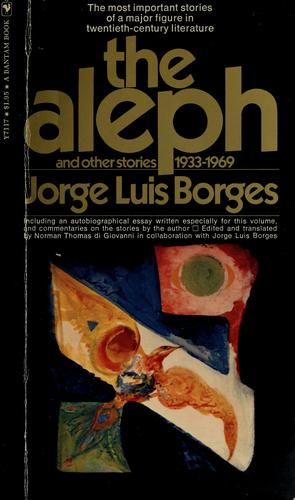
The Aleph and other stories, 1933-1969 (2004) Parents Guide: Is the book OK for kids?
Age Rating, Sex, Violence & Language
Dazzling and unmistakable in style, resonant in meaning, Jorge Luis Borges' 'The Aleph and Other Stories' contains the best of Borges' fiction. Included also is a lengthy autobiographical essay written especially for this volume. The twenty stories in this book cover the whole span and all the various facets of Borges' forty-year career as a short story writer.
Adult • 2004 • 248 pages • College Prep
This collection of short stories is a pillar of 20th-century literature, recommended for mature teens and adults due to its complex philosophical concepts and non-linear narratives. While generally high-brow, the collection contains moments of visceral violence—including knife fights and executions—that reflect the author's fascination with Argentinian 'compadritos' (hoodlums) and history. Parents should note that the prose is… Sign up for the full guide
Is The Aleph and other stories, 1933-1969 appropriate for kids?
This collection of short stories is a pillar of 20th-century literature, recommended for mature teens and adults due to its complex philosophical concepts and non-linear narratives. While generally high-brow, the collection contains moments of visceral violence—including knife… Read more — free account
Content severity in The Aleph and other stories, 1933-1969
What happens in The Aleph and other stories, 1933-1969, moment by moment
- p. 7 🔥 Mature Themes 3/10
- p. 22 ⚔ Violence & Gore 4/10
- p. 35 💬 Language 2/10
Sex and nudity in The Aleph and other stories, 1933-1969
Virtually non-existent or highly abstract across all stories in this collection. Borges focuses on intellectual and metaphysical pursuits rather than physical intimacy; there is no graphic sexual content or romance beyond mentions of past loves or brief, non-descriptive encounters. In 'Emma Zunz,' a sexual act is mentioned but occurs entirely off-page and is treated as a repulsive necessity for the protagonist's plot rather than an erotic moment. The prose remains detached and clinical when addressing human…
Read more — free accountViolence and gore in The Aleph and other stories, 1933-1969
Moderate and often sudden, reflecting a fascination with Argentinian 'compadrito' culture and historical brutality. Several stories feature formal duel culture, knife fights, and political assassinations; for example, 'The Dead Man' and 'Emma Zunz' involve cold-blooded killing and revenge. The violence is usually brief but can be stark and grim, such as the disembowelment in 'The Challenge' or the shocking fratricide in 'The Intruder.' Historical atrocities, such as the Roman conquests or frontier warfare with…
Read more — free accountLanguage in The Aleph and other stories, 1933-1969
Very mild throughout the text. As a classic work of literary fiction translated with a high degree of formality, it avoids modern profanity and vulgarity. Some older terms for ethnicity, such as 'negro' or 'Indian,' appear within their historical and cultural context of 19th-century Argentina. The tone is academic and elevated, with the narrator often speaking as a scholar or a detached observer. Characters in stories like 'The Dead Man' or 'The Challenge' use brief, tough-guy slang, but it rarely rises to the…
Read more — free accountDrugs, alcohol, and smoking in The Aleph and other stories, 1933-1969
Minor historical references to drinking occur in several stories. Characters may consume wine or spirits in tavern settings, such as the pulperias mentioned in 'The Challenge' and 'The Dead Man,' but there is no depiction of drug use or glorified intoxication. Alcohol is used as a tool for social bonding among gauchos or as a marker of a specific setting, rather than a focus of the plot. In 'The Aleph,' characters drink cognac while discussing literature and local history. The narrative maintains a sober…
Read more — free accountMature themes in The Aleph and other stories, 1933-1969
Highly sophisticated and potentially unsettling for those unprepared for existential inquiry. Themes include the nature of infinity, the loss of self, cyclical time, labyrinths, and the blurred line between reality and dreams. Some stories deal with profound existential dread, particularly 'The Immortal,' which explores the crushing weight of eternal life. The concept of the 'Aleph' itself—a point where all space is visible simultaneously—introduces themes of cosmic insignificance. Borges frequently explores the…
Read more — free accountFrequently Asked Questions
Is The Aleph and other stories, 1933-1969 appropriate for kids?
Bontent's parent guide suggests The Aleph and other stories, 1933-1969 is best for ages 16+. This collection of short stories is a pillar of 20th-century literature, recommended for mature teens and adults due to its complex philosophical concepts and non-linear narratives. While generally high-brow, the…
What age rating does The Aleph and other stories, 1933-1969 have?
Books don't carry official age ratings. The Aleph and other stories, 1933-1969 is shelved by its publisher as Adult, but that's a marketing category, not a content rating — Bontent's own review of what's actually on the page puts it at ages 16+.
What reading level is The Aleph and other stories, 1933-1969?
The Aleph and other stories, 1933-1969 is 248 pages and its reading level is College Prep. Bontent recommends it for ages 16+.
What is The Aleph and other stories, 1933-1969 about?
This collection of short stories is a pillar of 20th-century literature, recommended for mature teens and adults due to its complex philosophical concepts and non-linear narratives. While generally high-brow, the collection contains moments of visceral violence—including knife fights and executions—that reflect the…
Is there sex or nudity in The Aleph and other stories, 1933-1969?
Virtually non-existent or highly abstract across all stories in this collection. Borges focuses on intellectual and metaphysical pursuits rather than physical intimacy; there is no graphic sexual content or romance beyond mentions of past loves or brief…
How violent is The Aleph and other stories, 1933-1969?
Moderate and often sudden, reflecting a fascination with Argentinian 'compadrito' culture and historical brutality. Several stories feature formal duel culture, knife fights, and political assassinations; for example, 'The Dead Man' and 'Emma Zunz' involve…
Is the language in The Aleph and other stories, 1933-1969 appropriate for kids?
Very mild throughout the text. As a classic work of literary fiction translated with a high degree of formality, it avoids modern profanity and vulgarity. Some older terms for ethnicity, such as 'negro' or 'Indian,' appear within their historical and cultural…
Are drugs, alcohol, or smoking depicted in The Aleph and other stories, 1933-1969?
Minor historical references to drinking occur in several stories. Characters may consume wine or spirits in tavern settings, such as the pulperias mentioned in 'The Challenge' and 'The Dead Man,' but there is no depiction of drug use or glorified…
What mature themes appear in The Aleph and other stories, 1933-1969?
Highly sophisticated and potentially unsettling for those unprepared for existential inquiry. Themes include the nature of infinity, the loss of self, cyclical time, labyrinths, and the blurred line between reality and dreams. Some stories deal with profound…
Where can I read the full The Aleph and other stories, 1933-1969 parent guide?
Create a free Bontent account to unlock page-level notes, filter by your kids' ages, and save titles to your watchlist.
Less intense books for families
Sign up to filter







More biography books with parent guides
- The Dictionary of Lost Words parent guide
- Nine Lives parent guide
- Hana Khan Carries On parent guide
- ¡Hola Papi!: How to Come Out in a Walmart Parking Lot and Other Life Lessons parent guide
- Charlie the Choo-Choo parent guide
- The Return of the Young Prince parent guide
- The Name of the Wind / The Wise Man's Fear / The Slow Regard of Silent Things (The Kingkiller Chronicle #1-2.5) parent guide
- Fourth Wing (The Empyrean, #1) parent guide
- Clash of star-kings parent guide
- This House Will Feed parent guide
- The Bookshop on Rosemary Lane parent guide
- Told in letters parent guide
Short Stories books parents are checking
- Black Cake parent guide
- Moon Witch, Spider King parent guide
- American Gods: Tenth Anniversary (American Gods, #1) parent guide
- The House in the Cerulean Sea (Cerulean Chronicles, #1) parent guide
- Wuthering Heights, Agnes Grey, and Poems parent guide
- Works (Poems / Wuthering Heights) parent guide
- Babel: Or the Necessity of Violence: An Arcane History of the Oxford Translators' Revolution parent guide
- The Count of Monte Cristo parent guide
- No mind of man parent guide
More books by Jorge Luis Borges
More books with Bontent parent guides
- The Dictionary of Lost Words parent guide
- Just For The Cameras parent guide
- Tall Oaks parent guide
- Moon Witch, Spider King parent guide
- Charlie the Choo-Choo parent guide
- The Lightning Thief (Percy Jackson and the Olympians #1) parent guide
- Fourth Wing (The Empyrean, #1) parent guide
- The Martian Contingency parent guide
- American Gods: Tenth Anniversary (American Gods, #1) parent guide
- Clash of star-kings parent guide
- Blake Crouch's Dark Matter parent guide
- The Bookshop on Rosemary Lane parent guide
- Told in letters parent guide
- Wuthering Heights, Agnes Grey, and Poems parent guide
- The Battle of the Labyrinth (Percy Jackson and the Olympians, #4) parent guide
- Babel: Or the Necessity of Violence: An Arcane History of the Oxford Translators' Revolution parent guide