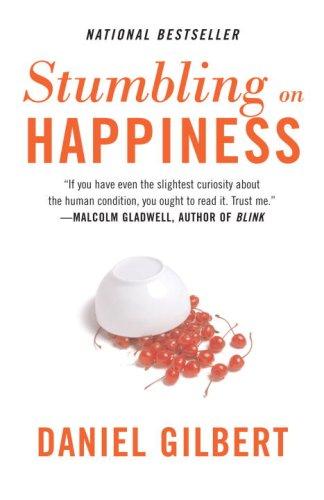
Stumbling on happiness (2006) Parents Guide: Is the book OK for kids?
Age Rating, Sex, Violence & Language
A smart and funny book by a prominent Harvard psychologist, which uses groundbreaking research and (often hilarious) anecdotes to show us why we're so lousy at predicting what will make us happy -- and what we can do about it.Most of us spend our lives steering ourselves toward the best of all possible futures, only to find that tomorrow rarely turns out as we had expected. Why? As Harvard psychologist Daniel Gilbert explains, when people try to imagine what the future will hold, they make some basic and consistent mistakes. Just as… Sign up for the full guide
Adult • 2006 • 310 pages • College Level / High School Senior
This is a non-fiction work by a Harvard psychologist that explores the cognitive biases and psychological illusions that prevent us from accurately predicting our future happiness. While written for a general adult audience, the book is appropriate for mature teenagers interested in science and psychology. Parents should note a few instances of mild profanity and scientific discussions of topics like conjoined twins, medical… Sign up for the full guide
Is Stumbling on happiness appropriate for kids?
This is a non-fiction work by a Harvard psychologist that explores the cognitive biases and psychological illusions that prevent us from accurately predicting our future happiness. While written for a general adult audience, the book is appropriate for mature teenagers… Read more — free account
Content severity in Stumbling on happiness
What happens in Stumbling on happiness, moment by moment
- p. 22 🔥 Mature Themes 2/10
- p. 35 🔥 Mature Themes 3/10
- p. 44 🔥 Mature Themes 1/10
Sex and nudity in Stumbling on happiness
The book contains brief, scientific references to sexual attraction and evolutionary biology. Daniel Gilbert uses evolutionary logic to explain human behavior, such as mentioning the 'genetic payoff' of mating or how men and women evaluate potential partners. There are mentions of 'getting the girl' or romantic choice in the context of decision-making, but no explicit descriptions, erotic content, or graphic language. The tone is consistently academic or dryly humorous, treating human reproduction as a functional…
Read more — free accountViolence and gore in Stumbling on happiness
None. The text deals with psychological concepts and does not contain physical violence, gore, or threats of harm. Gilbert occasionally mentions historical medical procedures or the physiological realities of conjoined twins in a clinical or informative context to illustrate points about brain function and perception. There are references to historical figures or social experiments that involve mild discomfort, but nothing involving physical combat or injury. The focus remains entirely on the internal workings of…
Read more — free accountLanguage in Stumbling on happiness
Occasional mild to moderate profanity resides within parenthetical jokes, footnotes, and anecdotal stories meant to engage a general adult audience. Terms like 'hell,' 'damn,' and 'crap' appear rarely, along with one or two more forceful colloquialisms used for comedic effect or to emphasize the frustration of cognitive errors. The language is never directed as an insult at the reader but rather reflects the author's conversational and irreverent writing style. Most teenagers would find the level of profanity…
Read more — free accountDrugs, alcohol, and smoking in Stumbling on happiness
Very light. The book mentions social dining and the consumption of food or drink in the context of sensory habituation and the 'declining marginal utility' of pleasure. For example, Gilbert uses the changing taste of wine or the diminishing joy of eating chocolate to explain how our brains adapt to repeated stimuli. There is no promotion, glamorization, or detailed depiction of illegal drug use or excessive alcohol consumption. Mentions of substances are strictly used as relatable analogies for psychological…
Read more — free accountMature themes in Stumbling on happiness
Complex psychological and philosophical themes dominate the text, including the nature of subjective experience, the flaws of memory, and the illusion of control. Gilbert explores heavy topics such as the impact of medical conditions like blindness or paralysis on human well-being to demonstrate that people are resilient. The narrative also tackles the existential dread of mortality and how the human brain's unique prefrontal cortex allows us to imagine a future that may never happen. These discussions are…
Read more — free accountFrequently Asked Questions
Is Stumbling on happiness appropriate for kids?
Bontent's parent guide suggests Stumbling on happiness is best for ages 14+. This is a non-fiction work by a Harvard psychologist that explores the cognitive biases and psychological illusions that prevent us from accurately predicting our future happiness. While written for a general adult…
What age rating does Stumbling on happiness have?
Books don't carry official age ratings. Stumbling on happiness is shelved by its publisher as Adult, but that's a marketing category, not a content rating — Bontent's own review of what's actually on the page puts it at ages 14+.
What reading level is Stumbling on happiness?
Stumbling on happiness is 310 pages and its reading level is College Level / High School Senior. Bontent recommends it for ages 14+.
What is Stumbling on happiness about?
This is a non-fiction work by a Harvard psychologist that explores the cognitive biases and psychological illusions that prevent us from accurately predicting our future happiness. While written for a general adult audience, the book is appropriate for mature teenagers interested in science and psychology. Parents…
Is there sex or nudity in Stumbling on happiness?
The book contains brief, scientific references to sexual attraction and evolutionary biology. Daniel Gilbert uses evolutionary logic to explain human behavior, such as mentioning the 'genetic payoff' of mating or how men and women evaluate potential partners…
How violent is Stumbling on happiness?
None. The text deals with psychological concepts and does not contain physical violence, gore, or threats of harm. Gilbert occasionally mentions historical medical procedures or the physiological realities of conjoined twins in a clinical or informative…
Is the language in Stumbling on happiness appropriate for kids?
Occasional mild to moderate profanity resides within parenthetical jokes, footnotes, and anecdotal stories meant to engage a general adult audience. Terms like 'hell,' 'damn,' and 'crap' appear rarely, along with one or two more forceful colloquialisms used…
Are drugs, alcohol, or smoking depicted in Stumbling on happiness?
Very light. The book mentions social dining and the consumption of food or drink in the context of sensory habituation and the 'declining marginal utility' of pleasure. For example, Gilbert uses the changing taste of wine or the diminishing joy of eating…
What mature themes appear in Stumbling on happiness?
Complex psychological and philosophical themes dominate the text, including the nature of subjective experience, the flaws of memory, and the illusion of control. Gilbert explores heavy topics such as the impact of medical conditions like blindness or…
Where can I read the full Stumbling on happiness parent guide?
Create a free Bontent account to unlock page-level notes, filter by your kids' ages, and save titles to your watchlist.
Less intense books for families
Sign up to filter








More non-fiction books with parent guides
- Last One To Die parent guide
- Atomic Habits: An Easy & Proven Way to Build Good Habits & Break Bad Ones parent guide
- The 48 Laws of Power parent guide
- Homo Deus: A Brief History of Tomorrow parent guide
- Killers of the Flower Moon: The Osage Murders and the Birth of the FBI parent guide
- The Wager: A Tale of Shipwreck, Mutiny and Murder parent guide
- I'll Be Gone in the Dark: One Woman's Obsessive Search for the Golden State Killer parent guide
- Factfulness: Ten Reasons We're Wrong About the World – and Why Things Are Better Than You Think parent guide
- Say Nothing: A True Story of Murder and Memory in Northern Ireland parent guide
- Born to Run: A Hidden Tribe, Superathletes, and the Greatest Race the World Has Never Seen parent guide
- Range: Why Generalists Triumph in a Specialized World parent guide
- Under the Banner of Heaven: A Story of Violent Faith parent guide
Psychology books parents are checking
- Atomic Habits parent guide
- Rich Dad, Poor Dad parent guide
- The Subtle Art of Not Giving a F*ck parent guide
- Biggest Ideas in the Universe 2 parent guide
- Think and Grow Rich parent guide
- Control Your Mind and Master Your Feelings parent guide
- Four Thousand Weeks: Time Management for Mortals parent guide
- An Absolutely Remarkable Thing (The Carls, #1) parent guide
- Everything Is Tuberculosis: The History and Persistence of Our Deadliest Infection parent guide
More books with Bontent parent guides
- The Dictionary of Lost Words parent guide
- Charged parent guide
- Clash of star-kings parent guide
- The Bookshop on Rosemary Lane parent guide
- The motion picture chums' outdoor exhibition, or, The film that solved a mystery parent guide
- The 48 Laws of Power parent guide
- The contemporary Negro novel parent guide
- The Dark Tower II: The Drawing of the Three (The Dark Tower, #2) parent guide
- Harry Potter parent guide
- Harry Potter and the Sorcerer's Stone (Harry Potter, #1) parent guide
- Arena 13 parent guide
- The Subtle Art of Not Giving a F*ck parent guide
- Biggest Ideas in the Universe 2 parent guide
- The Collapsing Empire (The Interdependency, #1) parent guide
- The Golden Enclaves (The Scholomance, #3) parent guide
- Mockingjay parent guide