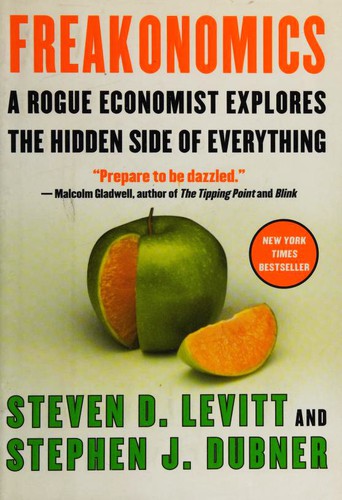
Freakonomics (2005) Parents Guide: Is the book OK for kids?
Age Rating, Sex, Violence & Language
*A Rogue Economist Explores the Hidden Side of Everything* Which is more dangerous, a gun or a swimming pool? What do schoolteachers and sumo wrestlers have in common? Why do drug dealers still live with their moms? How much do parents really matter? How did the legalization of abortion affect the rate of violent crime? These may not sound like typical questions for an economist to ask. But Steven D. Levitt is not a typical economist. He is a much-heralded scholar who studies the riddles of everyday life—from cheating and crime… Sign up for the full guide
Adult • 2005 • 336 pages • Grade 10-12
Freakonomics uses data analysis to explore unconventional social questions, earning its 14+ recommendation due to frank discussions of crime, drug culture, and social history. The book includes clinical but detailed examinations of the crack cocaine epidemic, the Ku Klux Klan, and the socio-economic impacts of abortion. It is intended for inquisitive teenagers and adults who can handle mature, sometimes controversial topics analyzed… Sign up for the full guide
Is Freakonomics appropriate for kids?
Freakonomics uses data analysis to explore unconventional social questions, earning its 14+ recommendation due to frank discussions of crime, drug culture, and social history. The book includes clinical but detailed examinations of the crack cocaine epidemic, the Ku Klux Klan… Read more — free account
Content severity in Freakonomics
What happens in Freakonomics, moment by moment
- p. 7 🔥 Mature Themes 3/10
- p. 22 🔥 Mature Themes 2/10
- p. 35 🔥 Mature Themes 3/10
Sex and nudity in Freakonomics
The book contains clinical discussions of sexual topics such as the economics of prostitution and the legalization of abortion. There are no graphic descriptions, but the subject matter is treated with adult frankness in a sociological context. The authors examine the Roe v. Wade decision not through a moral lens, but as a primary statistical driver for shifting crime rates. Later chapters touch upon the business models of sex workers to illustrate market incentives. Throughout these sections, the tone remains…
Read more — free accountViolence and gore in Freakonomics
Moderate depictions of real-world violence occur during discussions of the Ku Klux Klan's history and the inner workings of crack-selling gangs. The text describes violent methods of intimidation and homicide rates objectively rather than sensationally. Authors detail the high mortality rates for gang 'foot soldiers,' noting that selling drugs is statistically more dangerous than being on death row. There is also a comparison of childhood fatalities involving swimming pools versus firearms that may be unsettling…
Read more — free accountLanguage in Freakonomics
Language is generally professional and academic; however, occasional strong profanity and racial slurs appear within historical quotes or when describing the vernacular of gangs and the KKK. In Chapter 2, specific slurs are cited to illustrate the hateful rhetoric of Stetson Kennedy's era. The text also includes various instances of 'damn' or 'hell' when the authors adopt a more conversational or emphatic storytelling voice. Some transcripts from the J.T. gang records in Chapter 3 include harsh street vernacular…
Read more — free accountDrugs, alcohol, and smoking in Freakonomics
A significant portion of the book analyzes the organizational structure and financial incentives of crack cocaine gangs. While it does not glamorize use, it provides a detailed look at the drug trade, specifically focusing on the 1980s epidemic. The text describes how crack was marketed and distributed as a low-cost, high-volume product. There are no scenes of characters using drugs for recreation; instead, the focus remains on the 'corporate' hierarchy of dealers like J.T. and their foot soldiers. The discussion…
Read more — free accountMature themes in Freakonomics
Mature themes include the impact of abortion on crime rates, racial discrimination in naming conventions, the psychology of cheating, and systemic corruption. The book challenges traditional morality by asking if teachers or sumo wrestlers have the incentive to cheat for gain. It explores how parents' socio-economic status influences a child's success more than specific parenting techniques. One chapter looks deeply at the information asymmetry used by real estate agents to maximize their own profits. These topics…
Read more — free accountFrequently Asked Questions
Is Freakonomics appropriate for kids?
Bontent's parent guide suggests Freakonomics is best for ages 14+. Freakonomics uses data analysis to explore unconventional social questions, earning its 14+ recommendation due to frank discussions of crime, drug culture, and social history. The book includes clinical but detailed…
What age rating does Freakonomics have?
Books don't carry official age ratings. Freakonomics is shelved by its publisher as Adult, but that's a marketing category, not a content rating — Bontent's own review of what's actually on the page puts it at ages 14+.
What reading level is Freakonomics?
Freakonomics is 336 pages and its reading level is Grade 10-12. Bontent recommends it for ages 14+.
What is Freakonomics about?
Freakonomics uses data analysis to explore unconventional social questions, earning its 14+ recommendation due to frank discussions of crime, drug culture, and social history. The book includes clinical but detailed examinations of the crack cocaine epidemic, the Ku Klux Klan, and the socio-economic impacts of…
Is there sex or nudity in Freakonomics?
The book contains clinical discussions of sexual topics such as the economics of prostitution and the legalization of abortion. There are no graphic descriptions, but the subject matter is treated with adult frankness in a sociological context. The authors…
How violent is Freakonomics?
Moderate depictions of real-world violence occur during discussions of the Ku Klux Klan's history and the inner workings of crack-selling gangs. The text describes violent methods of intimidation and homicide rates objectively rather than sensationally…
Is the language in Freakonomics appropriate for kids?
Language is generally professional and academic; however, occasional strong profanity and racial slurs appear within historical quotes or when describing the vernacular of gangs and the KKK. In Chapter 2, specific slurs are cited to illustrate the hateful…
Are drugs, alcohol, or smoking depicted in Freakonomics?
A significant portion of the book analyzes the organizational structure and financial incentives of crack cocaine gangs. While it does not glamorize use, it provides a detailed look at the drug trade, specifically focusing on the 1980s epidemic. The text…
What mature themes appear in Freakonomics?
Mature themes include the impact of abortion on crime rates, racial discrimination in naming conventions, the psychology of cheating, and systemic corruption. The book challenges traditional morality by asking if teachers or sumo wrestlers have the incentive…
Where can I read the full Freakonomics parent guide?
Create a free Bontent account to unlock page-level notes, filter by your kids' ages, and save titles to your watchlist.
Less intense books for families
Sign up to filter









More business books with parent guides
- Last One To Die parent guide
- Atomic Habits: An Easy & Proven Way to Build Good Habits & Break Bad Ones parent guide
- Atomic Habits parent guide
- The 48 Laws of Power parent guide
- Homo Deus: A Brief History of Tomorrow parent guide
- Biggest Ideas in the Universe 2 parent guide
- Killers of the Flower Moon: The Osage Murders and the Birth of the FBI parent guide
- Think and Grow Rich parent guide
- The Wager: A Tale of Shipwreck, Mutiny and Murder parent guide
- Control Your Mind and Master Your Feelings parent guide
- I'll Be Gone in the Dark: One Woman's Obsessive Search for the Golden State Killer parent guide
- Four Thousand Weeks: Time Management for Mortals parent guide
Economics books parents are checking
- Factfulness: Ten Reasons We're Wrong About the World – and Why Things Are Better Than You Think parent guide
- An Absolutely Remarkable Thing (The Carls, #1) parent guide
- Everything Is Tuberculosis: The History and Persistence of Our Deadliest Infection parent guide
- The Psychology of Money parent guide
- Cultish: The Language of Fanaticism parent guide
- Range: Why Generalists Triumph in a Specialized World parent guide
- The Kind Worth Killing (Ingrid Bergman #1) parent guide
- How to Change Your Mind: The New Science of Psychedelics parent guide
- The Body: A Guide for Occupants parent guide
- Flash Boys: A Wall Street Revolt parent guide
More books by Steven D. Levitt
More books with Bontent parent guides
- The Dictionary of Lost Words parent guide
- Tall Oaks parent guide
- Charged parent guide
- The Midnight Girls parent guide
- The Name of the Wind / The Wise Man's Fear / The Slow Regard of Silent Things (The Kingkiller Chronicle #1-2.5) parent guide
- Clash of star-kings parent guide
- Babel: Or the Necessity of Violence: An Arcane History of the Oxford Translators' Revolution parent guide
- The motion picture chums' outdoor exhibition, or, The film that solved a mystery parent guide
- Before They Are Hanged (The First Law, #2) parent guide
- 2001: A Space Odyssey parent guide
- The Dark Tower II: The Drawing of the Three (The Dark Tower, #2) parent guide
- With This Ring? parent guide
- Tower of Dawn (Throne of Glass, #6) parent guide
- The Institute parent guide
- Moby-Dick or, The Whale parent guide
- Arena 13 parent guide