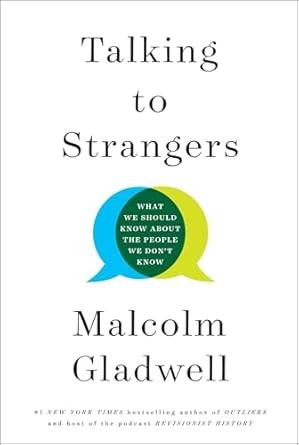
Talking to Strangers (2019) Parents Guide: Is the book OK for kids?
Age Rating, Sex, Violence & Language
Malcolm Gladwell, host of the podcast Revisionist History and author of the #1 New York Times bestseller Outliers, offers a powerful examination of our interactions with strangers--and why they often go wrong . How did Fidel Castro fool the CIA for a generation? Why did Neville Chamberlain think he could trust Adolf Hitler? Why are campus sexual assaults on the rise? Do television sitcoms teach us something about the way we relate to each other that isn't true? Talking to Strangers is a classically Gladwellian intellectual adventure… Sign up for the full guide
Adult • 2019 • 353 pages • Grade 11-12
This non-fiction work explores how human communication failures lead to tragic outcomes, making it suitable for mature teens and adults. The book earns its suggested age due to heavy, clinical, and sometimes graphic discussions of sensitive topics including sexual assault, pedophilia, suicide, and police misconduct. Readers should be prepared for detailed accounts of real-world tragedies, including the Jerry Sandusky case and the death… Sign up for the full guide
Is Talking to Strangers appropriate for kids?
This non-fiction work explores how human communication failures lead to tragic outcomes, making it suitable for mature teens and adults. The book earns its suggested age due to heavy, clinical, and sometimes graphic discussions of sensitive topics including sexual assault… Read more — free account
Content severity in Talking to Strangers
What happens in Talking to Strangers, moment by moment
- p. 10 ⚔ Violence & Gore 4/10
- p. 28 🔥 Mature Themes 2/10
- p. 45 🔥 Mature Themes 3/10
Sex and nudity in Talking to Strangers
The book contains clinical and journalistic analysis of sexual assault and pedophilia. It includes detailed descriptions of Jerry Sandusky’s crimes, including the 'Second Mile' foundation context and the specific ways victims were groomed. The Brock Turner case is examined through the lens of campus party culture, providing a frank discussion of penetration and the physiological effects of alcohol on sexual consent and memory. In Chapter 9, Gladwell explores 'blackouts' and how they complicate legal definitions of…
Read more — free accountViolence and gore in Talking to Strangers
Violence is discussed through the lens of historical events, psychological experiments, and police encounters. This includes detailed accounts of the interrogation of suspected spies like Ana Montes and the high-stakes pressure of CIA 'moles.' The text provides a clinical description of the suicide by gas of Sylvia Plath and the correlation between coal gas availability and death rates. Perhaps most prominently, the book deconstructs the high-profile arrest and subsequent suicide of Sandra Bland, including the…
Read more — free accountLanguage in Talking to Strangers
Moderate profanity is used primarily within the context of direct quotes from transcripts, court documents, and police recordings. Terms like 'sh*t,' 'bitch,' 'damn,' and 'hell' appear in the retelling of the Sandra Bland traffic stop to show the escalating aggression of the officer. In chapters discussing Bernie Madoff or Jerry Sandusky, quotes from victims or investigators occasionally include strong language reflecting emotional distress. The word 'f**k' appears sparingly in professional or legal citations. The…
Read more — free accountDrugs, alcohol, and smoking in Talking to Strangers
Alcohol consumption is analyzed as a psychological variable in social interactions rather than for recreational appeal. The text specifically details 'blackout' states and how heavy drinking impacts a person's ability to process surroundings and consent. Gladwell discusses the biological mechanics of how alcohol affects the hippocampus and prevents the formation of memories. There are also references to the use of 'truth serums' like sodium amytal in early espionage and interrogation history. The discussion is…
Read more — free accountMature themes in Talking to Strangers
Mature themes include systemic racism, the fallibility of human judgment, and the psychological concept of 'default to truth.' Gladwell explores the tragic consequences of institutional transparency failures in the Madoff and Sandusky cases. The concept of 'coupling' is introduced, suggesting that certain behaviors are tied to specific locations and circumstances. There is a heavy focus on grief, the failure of the legal system, and the danger of assuming we can understand a stranger's internal state through their…
Read more — free accountFrequently Asked Questions
Is Talking to Strangers appropriate for kids?
Bontent's parent guide suggests Talking to Strangers is best for ages 16+. This non-fiction work explores how human communication failures lead to tragic outcomes, making it suitable for mature teens and adults. The book earns its suggested age due to heavy, clinical, and sometimes graphic…
What age rating does Talking to Strangers have?
Books don't carry official age ratings. Talking to Strangers is shelved by its publisher as Adult, but that's a marketing category, not a content rating — Bontent's own review of what's actually on the page puts it at ages 16+.
What reading level is Talking to Strangers?
Talking to Strangers is 353 pages and its reading level is Grade 11-12. Bontent recommends it for ages 16+.
What is Talking to Strangers about?
This non-fiction work explores how human communication failures lead to tragic outcomes, making it suitable for mature teens and adults. The book earns its suggested age due to heavy, clinical, and sometimes graphic discussions of sensitive topics including sexual assault, pedophilia, suicide, and police misconduct…
Is there sex or nudity in Talking to Strangers?
The book contains clinical and journalistic analysis of sexual assault and pedophilia. It includes detailed descriptions of Jerry Sandusky’s crimes, including the 'Second Mile' foundation context and the specific ways victims were groomed. The Brock Turner…
How violent is Talking to Strangers?
Violence is discussed through the lens of historical events, psychological experiments, and police encounters. This includes detailed accounts of the interrogation of suspected spies like Ana Montes and the high-stakes pressure of CIA 'moles.' The text…
Is the language in Talking to Strangers appropriate for kids?
Moderate profanity is used primarily within the context of direct quotes from transcripts, court documents, and police recordings. Terms like 'sh*t,' 'bitch,' 'damn,' and 'hell' appear in the retelling of the Sandra Bland traffic stop to show the escalating…
Are drugs, alcohol, or smoking depicted in Talking to Strangers?
Alcohol consumption is analyzed as a psychological variable in social interactions rather than for recreational appeal. The text specifically details 'blackout' states and how heavy drinking impacts a person's ability to process surroundings and consent…
What mature themes appear in Talking to Strangers?
Mature themes include systemic racism, the fallibility of human judgment, and the psychological concept of 'default to truth.' Gladwell explores the tragic consequences of institutional transparency failures in the Madoff and Sandusky cases. The concept of…
Where can I read the full Talking to Strangers parent guide?
Create a free Bontent account to unlock page-level notes, filter by your kids' ages, and save titles to your watchlist.
Less intense books for families
Sign up to filter










More non-fiction books with parent guides
- Last One To Die parent guide
- Atomic Habits: An Easy & Proven Way to Build Good Habits & Break Bad Ones parent guide
- The 48 Laws of Power parent guide
- Homo Deus: A Brief History of Tomorrow parent guide
- Killers of the Flower Moon: The Osage Murders and the Birth of the FBI parent guide
- The Wager: A Tale of Shipwreck, Mutiny and Murder parent guide
- I'll Be Gone in the Dark: One Woman's Obsessive Search for the Golden State Killer parent guide
- Factfulness: Ten Reasons We're Wrong About the World – and Why Things Are Better Than You Think parent guide
- Say Nothing: A True Story of Murder and Memory in Northern Ireland parent guide
- Born to Run: A Hidden Tribe, Superathletes, and the Greatest Race the World Has Never Seen parent guide
- Range: Why Generalists Triumph in a Specialized World parent guide
- Under the Banner of Heaven: A Story of Violent Faith parent guide
Psychology books parents are checking
More books by Malcolm Gladwell
- David and Goliath: Underdogs, Misfits, and the Art of Battling Giants parent guide
- The Bomber Mafia: A Dream, a Temptation, and the Longest Night of the Second World War parent guide
- Outliers parent guide
- Outliers: The Story of Success parent guide
- The Tipping Point parent guide
- The Tipping Point: How Little Things Can Make a Big Difference parent guide
- Blink: The Power of Thinking Without Thinking parent guide
- Talking to Strangers: What We Should Know About the People We Don't Know parent guide
- David and Goliath parent guide
More books with Bontent parent guides
- Black Cake parent guide
- The Dictionary of Lost Words parent guide
- Just For The Cameras parent guide
- Nine Lives parent guide
- Operation Bounce House parent guide
- Kingdom of Shadow and Light parent guide
- Charged parent guide
- ¡Hola Papi!: How to Come Out in a Walmart Parking Lot and Other Life Lessons parent guide
- You Did Nothing Wrong parent guide
- The Hobbit, or There and Back Again parent guide
- Last One To Die parent guide
- Ghosted: An American Story parent guide
- The Lightning Thief (Percy Jackson and the Olympians #1) parent guide
- Unrivaled parent guide
- The Return of the Young Prince parent guide
- Fourth Wing (The Empyrean, #1) parent guide