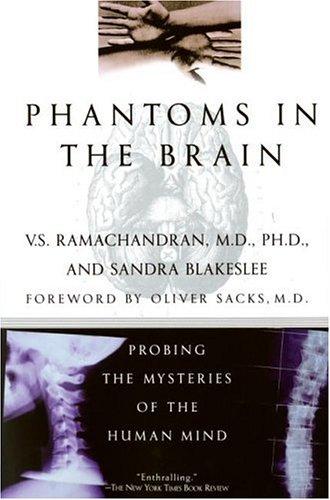
Phantoms in the Brain: Probing the Mysteries of the Human Mind (1999) Parents Guide: Is the book OK for kids?
Age Rating, Sex, Violence & Language
Neuroscientist V.S. Ramachandran is internationally renowned for uncovering answers to the deep and quirky questions of human nature that few scientists have dared to address. His bold insights about the brain are matched only by the stunning simplicity of his experiments -- using such low-tech tools as cotton swabs, glasses of water and dime-store mirrors. In Phantoms in the Brain, Dr. Ramachandran recounts how his work with patients who have bizarre neurological disorders has shed new light on the deep architecture of the brain… Sign up for the full guide
Adult • 1999 • 352 pages • Lexile 1200L (high school or more advanced reading difficulty)
Adult popular neuroscience built around case studies of people with strange neurological conditions - phantom limbs, denial of paralysis, the conviction that a parent has been replaced by an impostor. The unsettling material is clinical: amputation, brain injury, and one recurring case involving inappropriate sexual behavior after temporal lobe damage. Curious older teens read this happily and it is a genuinely good gateway into… Sign up for the full guide
Is Phantoms in the Brain: Probing the Mysteries of the Human Mind appropriate for kids?
Adult popular neuroscience built around case studies of people with strange neurological conditions - phantom limbs, denial of paralysis, the conviction that a parent has been replaced by an impostor. The unsettling material is clinical: amputation, brain injury, and one… Read more — free account
Content severity in Phantoms in the Brain: Probing the Mysteries of the Human Mind
What happens in Phantoms in the Brain: Probing the Mysteries of the Human Mind, moment by moment
- p. 2 🔥 Mature Themes 1/10
- p. 22 🔥 Mature Themes 3/10
- p. 35 ⚔ Violence & Gore 2/10
Sex and nudity in Phantoms in the Brain: Probing the Mysteries of the Human Mind
Sexual content is present but strictly clinical and academic in nature. Ramachandran discusses patients whose brain damage produced hypersexuality, fetishes, or altered sexual identity, such as a man with a phantom foot who experiences orgasmic sensations in the missing limb during sex. The text also covers the neurology of arousal and the limbic system's role in human bonding and attraction. While the descriptions are candid and frank, they are framed as case reports and scientific inquiry rather than for…
Read more — free accountViolence and gore in Phantoms in the Brain: Probing the Mysteries of the Human Mind
The book details medical violence rather than dramatic or intentional harm. Readers encounter descriptions of amputations, strokes, gunshot wounds, and traumatic head injuries from car accidents that serve as the catalysts for the neurological conditions discussed. There are clinical accounts of neurosurgical procedures, including the physical removal of brain tissue and the probing of the cortex with electrodes while patients are awake. While the tone is objective and scholarly, the anatomical details of injuries…
Read more — free accountLanguage in Phantoms in the Brain: Probing the Mysteries of the Human Mind
The text is entirely free of profanity or aggressive language. It is written in a sophisticated yet accessible style suited for a popular science audience, focusing on clear communication of complex neurological concepts. The prose remains clean, professional, and conversational throughout all chapters, with no use of slurs or expletives. Even during the most intense case studies, the authors maintain a respectful and clinical tone. This is an excellent example of high-level scientific writing that does not rely…
Read more — free accountDrugs, alcohol, and smoking in Phantoms in the Brain: Probing the Mysteries of the Human Mind
Substance use is minimal and limited to clinical contexts within the narrative. The authors make passing references to pharmaceutical drugs used in the treatment of epilepsy, chronic pain, and psychiatric disorders. There are brief mentions of research chemicals and the historical use of substances in early neuroscience experiments to map brain functions. No recreational drug use, alcoholism, or glamorization of substance abuse occurs in the text. The focus remains exclusively on how chemicals interact with neural…
Read more — free accountMature themes in Phantoms in the Brain: Probing the Mysteries of the Human Mind
The book explores deeply existential themes regarding how the brain assembles the concept of selfhood, including free will, body image, and religious experience. Ramachandran argues that denial and confabulation are normal brain functions that become visible when the brain's internal monitoring systems malfunction, which can be philosophically destabilizing for the reader. Specific case studies, like Capgras syndrome or phantom limbs, challenge the reader's perception of reality and the reliability of their own…
Read more — free accountFrequently Asked Questions
Is Phantoms in the Brain: Probing the Mysteries of the Human Mind appropriate for kids?
Bontent's parent guide suggests Phantoms in the Brain: Probing the Mysteries of the Human Mind is best for ages 18+. Adult popular neuroscience built around case studies of people with strange neurological conditions - phantom limbs, denial of paralysis, the conviction that a parent has been replaced by an impostor. The unsettling…
What age rating does Phantoms in the Brain: Probing the Mysteries of the Human Mind have?
Books don't carry official age ratings. Phantoms in the Brain: Probing the Mysteries of the Human Mind is published for a Adult audience, and Bontent's independent parent guide recommends it for ages 18+.
What reading level is Phantoms in the Brain: Probing the Mysteries of the Human Mind?
Phantoms in the Brain: Probing the Mysteries of the Human Mind is 352 pages and its reading level is Lexile 1200L (high school or more advanced reading difficulty). Bontent recommends it for ages 18+.
What is Phantoms in the Brain: Probing the Mysteries of the Human Mind about?
Adult popular neuroscience built around case studies of people with strange neurological conditions - phantom limbs, denial of paralysis, the conviction that a parent has been replaced by an impostor. The unsettling material is clinical: amputation, brain injury, and one recurring case involving inappropriate sexual…
Is there sex or nudity in Phantoms in the Brain: Probing the Mysteries of the Human Mind?
Sexual content is present but strictly clinical and academic in nature. Ramachandran discusses patients whose brain damage produced hypersexuality, fetishes, or altered sexual identity, such as a man with a phantom foot who experiences orgasmic sensations in…
How violent is Phantoms in the Brain: Probing the Mysteries of the Human Mind?
The book details medical violence rather than dramatic or intentional harm. Readers encounter descriptions of amputations, strokes, gunshot wounds, and traumatic head injuries from car accidents that serve as the catalysts for the neurological conditions…
Is the language in Phantoms in the Brain: Probing the Mysteries of the Human Mind appropriate for kids?
The text is entirely free of profanity or aggressive language. It is written in a sophisticated yet accessible style suited for a popular science audience, focusing on clear communication of complex neurological concepts. The prose remains clean…
Are drugs, alcohol, or smoking depicted in Phantoms in the Brain: Probing the Mysteries of the Human Mind?
Substance use is minimal and limited to clinical contexts within the narrative. The authors make passing references to pharmaceutical drugs used in the treatment of epilepsy, chronic pain, and psychiatric disorders. There are brief mentions of research…
What mature themes appear in Phantoms in the Brain: Probing the Mysteries of the Human Mind?
The book explores deeply existential themes regarding how the brain assembles the concept of selfhood, including free will, body image, and religious experience. Ramachandran argues that denial and confabulation are normal brain functions that become visible…
Where can I read the full Phantoms in the Brain: Probing the Mysteries of the Human Mind parent guide?
Create a free Bontent account to unlock page-level notes, filter by your kids' ages, and save titles to your watchlist.
More neurosciences books with parent guides
Popular Science books parents are checking
- Atomic Habits: An Easy & Proven Way to Build Good Habits & Break Bad Ones parent guide
- Homo Deus: A Brief History of Tomorrow parent guide
- Biggest Ideas in the Universe 2 parent guide
- Four Thousand Weeks: Time Management for Mortals parent guide
- Factfulness: Ten Reasons We're Wrong About the World – and Why Things Are Better Than You Think parent guide
- An Absolutely Remarkable Thing (The Carls, #1) parent guide
- Everything Is Tuberculosis: The History and Persistence of Our Deadliest Infection parent guide
- Cultish: The Language of Fanaticism parent guide
- Range: Why Generalists Triumph in a Specialized World parent guide
- How to Change Your Mind: The New Science of Psychedelics parent guide
- The Body: A Guide for Occupants parent guide
- Being Mortal: Medicine and What Matters in the End parent guide
More books with Bontent parent guides
- The Dictionary of Lost Words parent guide
- Tall Oaks parent guide
- Charged parent guide
- The Midnight Girls parent guide
- The Name of the Wind / The Wise Man's Fear / The Slow Regard of Silent Things (The Kingkiller Chronicle #1-2.5) parent guide
- The Martian Contingency parent guide
- Clash of star-kings parent guide
- Blake Crouch's Dark Matter parent guide
- The Bookshop on Rosemary Lane parent guide
- Atomic Habits: An Easy & Proven Way to Build Good Habits & Break Bad Ones parent guide
- Babel: Or the Necessity of Violence: An Arcane History of the Oxford Translators' Revolution parent guide
- The Battle of the Labyrinth (Percy Jackson and the Olympians, #4) parent guide
- The motion picture chums' outdoor exhibition, or, The film that solved a mystery parent guide
- Before They Are Hanged (The First Law, #2) parent guide
- 2001: A Space Odyssey parent guide
- The contemporary Negro novel parent guide