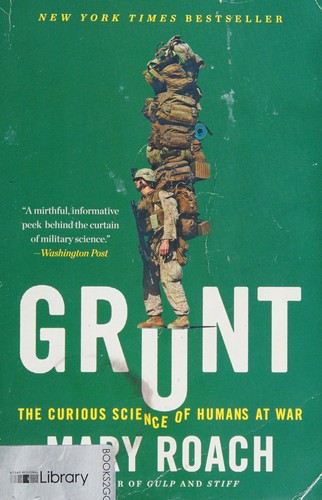
Grunt: The Curious Science of Humans at War (2016) Parents Guide: Is the book OK for kids?
Age Rating, Sex, Violence & Language
"'Grunt' tackles the science behind some of a soldier's most challenging adversaries-- panic, exhaustion, heat, noise-- and introduces us to the scientists who seek to conquer them"--
Adult • 2016 • 288 pages • Lexile 1230L (high school or more advanced reading difficulty)
An adult popular-science book exploring the strange research that keeps soldiers alive, from heat, noise and sleep deprivation to diarrhea, flies and combat injuries. It isn't about battle itself, but it does describe traumatic wounds, genital injuries and transplants, and use of maggots in wound care in a frank, humorous tone. Best for adults or mature older teens interested in medicine or the military who won't be thrown by blunt… Continue to this guide
Is Grunt: The Curious Science of Humans at War appropriate for kids?
An adult popular-science book exploring the strange research that keeps soldiers alive, from heat, noise and sleep deprivation to diarrhea, flies and combat injuries. It isn't about battle itself, but it does describe traumatic wounds, genital injuries and transplants, and use… Continue with an account
Content severity in Grunt: The Curious Science of Humans at War
What happens in Grunt: The Curious Science of Humans at War, moment by moment
- p. 15 💬 Language 2/10
- p. 30 🔥 Mature Themes 3/10
- p. 38 ⚔ Violence & Gore 4/10
Sex and nudity in Grunt: The Curious Science of Humans at War
While there are no scenes of a sexual nature, one entire chapter focuses on the sensitive subject of genital injuries caused by IEDs and the subsequent science of penile transplants. Mary Roach interviews surgeons who specialize in Genitourinary Reconstruction, discussing the logistics of nerve repair and donor tissue in a clinical yet frank manner. The text includes a few anatomical jokes and lighthearted observations typical of the author's style, but the focus remains on restorative surgery for veterans. Some…
Continue with an accountViolence and gore in Grunt: The Curious Science of Humans at War
The book contains no traditional combat scenes, but it provides graphic descriptions of the physical damage inflicted by modern warfare. Roach visits the Strategic Operations center where she observes hyper-realistic 'cut suits' and simulated casualties designed to prepare medics for gory trauma. She describes the mechanics of IED blast injuries, the effects of shark attacks on sailors, and the way ballistic fabrics are tested for puncture resistance. There are also clinical descriptions of how cadavers are used…
Continue with an accountLanguage in Grunt: The Curious Science of Humans at War
The language in the book is moderate and reflects the authentic speech of military personnel and researchers. Occasional profanity occurs, including 'fuck' and 'shit,' primarily appearing within direct quotes from soldiers, medics, or the author’s own internal monologue. These instances are sporadic rather than pervasive and are used to convey the stress or intensity of the military environment. The tone is more akin to a high-level documentary or a long-form journalistic piece where salty language is used for…
Continue with an accountDrugs, alcohol, and smoking in Grunt: The Curious Science of Humans at War
Substance use is discussed primarily from a pharmacological and performance-enhancing perspective within military research. The book explores the use of stimulants like caffeine to help soldiers manage extreme sleep deprivation during operations. There are also mentions of modern medication used to treat chronic diarrhea and infection on the battlefield, though these are presented as medical necessities. One section touches upon the historical use of drugs to manage stress, but there is no glorification of…
Continue with an accountMature themes in Grunt: The Curious Science of Humans at War
The central themes revolve around the ingenuity of military science and the human cost of modern warfare. Roach explores how researchers address non-combat threats like extreme heat, noise, and disease to ensure soldier survivability. There is a deep undercurrent of respect for wounded veterans, focusing on their resilience and the psychological challenges of PTSD and disfigurement. The ethics of using cadavers for blast research is touched upon, highlighting the tension between scientific progress and the…
Continue with an accountFrequently Asked Questions
Is Grunt: The Curious Science of Humans at War appropriate for kids?
Bontent's parent guide suggests Grunt: The Curious Science of Humans at War is best for ages 18+. An adult popular-science book exploring the strange research that keeps soldiers alive, from heat, noise and sleep deprivation to diarrhea, flies and combat injuries. It isn't about battle itself, but it does describe…
What age rating does Grunt: The Curious Science of Humans at War have?
Books don't carry official age ratings. Grunt: The Curious Science of Humans at War is published for a Adult audience, and Bontent's independent parent guide recommends it for ages 18+.
What reading level is Grunt: The Curious Science of Humans at War?
Grunt: The Curious Science of Humans at War is 288 pages and its reading level is Lexile 1230L (high school or more advanced reading difficulty). Bontent recommends it for ages 18+.
What is Grunt: The Curious Science of Humans at War about?
An adult popular-science book exploring the strange research that keeps soldiers alive, from heat, noise and sleep deprivation to diarrhea, flies and combat injuries. It isn't about battle itself, but it does describe traumatic wounds, genital injuries and transplants, and use of maggots in wound care in a frank…
Is there sex or nudity in Grunt: The Curious Science of Humans at War?
While there are no scenes of a sexual nature, one entire chapter focuses on the sensitive subject of genital injuries caused by IEDs and the subsequent science of penile transplants. Mary Roach interviews surgeons who specialize in Genitourinary…
How violent is Grunt: The Curious Science of Humans at War?
The book contains no traditional combat scenes, but it provides graphic descriptions of the physical damage inflicted by modern warfare. Roach visits the Strategic Operations center where she observes hyper-realistic 'cut suits' and simulated casualties…
Is the language in Grunt: The Curious Science of Humans at War appropriate for kids?
The language in the book is moderate and reflects the authentic speech of military personnel and researchers. Occasional profanity occurs, including 'fuck' and 'shit,' primarily appearing within direct quotes from soldiers, medics, or the author’s own…
Are drugs, alcohol, or smoking depicted in Grunt: The Curious Science of Humans at War?
Substance use is discussed primarily from a pharmacological and performance-enhancing perspective within military research. The book explores the use of stimulants like caffeine to help soldiers manage extreme sleep deprivation during operations. There are…
What mature themes appear in Grunt: The Curious Science of Humans at War?
The central themes revolve around the ingenuity of military science and the human cost of modern warfare. Roach explores how researchers address non-combat threats like extreme heat, noise, and disease to ensure soldier survivability. There is a deep…
Where can I read the full Grunt: The Curious Science of Humans at War parent guide?
Create a free Bontent account to save titles and find family picks. Full page-level details use guide credits or Bontent Parent membership.
More history books with parent guides
- Last One To Die parent guide
- Essays in romantic literature parent guide
- Atomic Habits: An Easy & Proven Way to Build Good Habits & Break Bad Ones parent guide
- Told in letters parent guide
- Stories from English history parent guide
- The biography of Sir Gawain in medieval French literature parent guide
- The 48 Laws of Power parent guide
- The contemporary Negro novel parent guide
- The modern novel parent guide
- A century of the English novel parent guide
- Jonathan Strange & Mr Norrell parent guide
- Homo Deus: A Brief History of Tomorrow parent guide
Popular Science books parents are checking
- Biggest Ideas in the Universe 2 parent guide
- The Wager: A Tale of Shipwreck, Mutiny and Murder parent guide
- Private Suhren parent guide
- Factfulness: Ten Reasons We're Wrong About the World – and Why Things Are Better Than You Think parent guide
- An Absolutely Remarkable Thing (The Carls, #1) parent guide
- Everything Is Tuberculosis: The History and Persistence of Our Deadliest Infection parent guide
- This is Going to Hurt: Secret Diaries of a Junior Doctor parent guide
- Range: Why Generalists Triumph in a Specialized World parent guide
- Empire of Pain parent guide
- How to Change Your Mind: The New Science of Psychedelics parent guide
More books by Mary Roach
More books with Bontent parent guides
- Sunlight Finds You parent guide
- The Hobbit, or There and Back Again parent guide
- Napoleon Boswell parent guide
- Queen of Lombard Street parent guide
- Farm friends story book parent guide
- Eragon (The Inheritance Cycle, #1) parent guide
- Works (Poems / Wuthering Heights) parent guide
- The Battle of the Labyrinth (Percy Jackson and the Olympians, #4) parent guide
- The Cruel Prince (The Folk of the Air, #1) parent guide
- You and I and life parent guide
- The travels of John Wryland parent guide
- The black Homer of Jimtown parent guide
- 2001: A Space Odyssey parent guide
- The biography of Sir Gawain in medieval French literature parent guide
- Mother in modern story parent guide
- The Bad Beginning (A Series of Unfortunate Events #1) parent guide