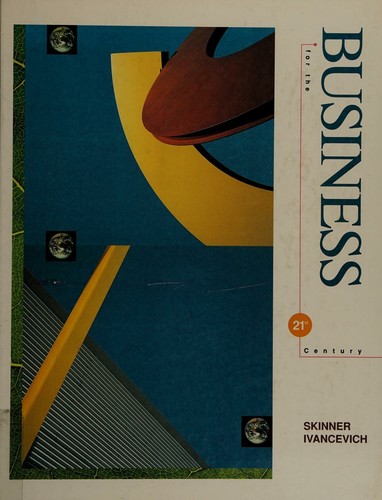
Business for the 21st century (1992) Parents Guide: Is the book OK for kids?
Age Rating, Sex, Violence & Language
Burrhus Frederic Skinner (March 20, 1904 – August 18, 1990) was an American psychologist, behaviorist, inventor, and social philosopher. He was the Edgar Pierce Professor of Psychology at Harvard University from 1948 until his retirement in 1974. Skinner developed behavior analysis, especially the philosophy of radical behaviorism, and founded the experimental analysis of behavior, a school of experimental research psychology. He also used operant conditioning to strengthen behavior, considering the rate of response to be the most… Sign up for the full guide
Adult • 1992 • 864 pages • College Level
This is a non-fiction academic textbook regarding management science and organizational structure from the early 1990s. It contains no adult content, graphic violence, or profanity, making it appropriate for students or professionals interested in historical business theory. The text focuses on corporate strategies, marketing, and the emergence of global trade during the late 20th century.
Is Business for the 21st century appropriate for kids?
This is a non-fiction academic textbook regarding management science and organizational structure from the early 1990s. It contains no adult content, graphic violence, or profanity, making it appropriate for students or professionals interested in historical business theory. The… Read more — free account
Content severity in Business for the 21st century
What happens in Business for the 21st century, moment by moment
- p. 15 🔥 Mature Themes 1/10
- p. 28 🔥 Mature Themes 1/10
- p. 45 🔥 Mature Themes 2/10
Sex and nudity in Business for the 21st century
There is no sexual content in this textbook. The narrative focuses entirely on the logistics of management, organizational charts, and the mechanics of the market. Its tone is formal and pedagogical, typical of higher education materials from the early 1990s. The book does not contain references to human sexuality, romantic relationships, or anatomical descriptions. It remains strictly professional throughout all three hundred pages.
Violence and gore in Business for the 21st century
Physical violence is entirely absent from the text. The only use of aggressive terminology refers to market competition, such as 'hostile takeovers' or 'cutting costs' within a corporate framework. There are no depictions of physical harm, criminal acts, or threats to individuals. The book maintains a dry, analytical tone regarding business operations and systemic structures. Even historical conflicts are discussed only through the lens of their economic impact on global trade.
Language in Business for the 21st century
The text contains no profanity, vulgarity, or derogatory slurs. The vocabulary is dense and academic, utilizing technical terms like 'economies of scale,' 'diversification,' and 'synergy.' Communication styles analyzed within the text focus on professional efficiency and corporate memo structures. There are no instances of characters or case studies using informal or offensive dialogue. The reading level is intended for college students and business professionals.
Drugs, alcohol, and smoking in Business for the 21st century
There is no depiction of substance use or abuse in this academic work. The text may occasionally reference the alcohol or tobacco industries when discussing commodity markets or regulatory environments, but these are handled with clinical detachment. No characters are shown consuming drugs or alcohol, and there is no promotion of such behaviors. The focus remains on the supply chain and consumer behavior rather than personal usage. The content is safe for all audiences regarding substance-related concerns.
Mature themes in Business for the 21st century
The book explores complex themes involving the ethical management of human capital and the pressure of global competition. It delves into the stressors of organizational restructuring and the socioeconomic implications of labor relations. Discussions include the impact of manufacturing on the environment and the moral obligations of corporations to their local communities. These topics are presented as case studies for critical thinking and professional development. The overall theme is the adaptation of…
Read more — free accountFrequently Asked Questions
Is Business for the 21st century appropriate for kids?
Bontent's parent guide suggests Business for the 21st century is best for ages 16+. This is a non-fiction academic textbook regarding management science and organizational structure from the early 1990s. It contains no adult content, graphic violence, or profanity, making it appropriate for students or…
What age rating does Business for the 21st century have?
Books don't carry official age ratings. Business for the 21st century is shelved by its publisher as Adult, but that's a marketing category, not a content rating — Bontent's own review of what's actually on the page puts it at ages 16+.
What reading level is Business for the 21st century?
Business for the 21st century is 864 pages and its reading level is College Level. Bontent recommends it for ages 16+.
What is Business for the 21st century about?
This is a non-fiction academic textbook regarding management science and organizational structure from the early 1990s. It contains no adult content, graphic violence, or profanity, making it appropriate for students or professionals interested in historical business theory. The text focuses on corporate strategies…
Is there sex or nudity in Business for the 21st century?
There is no sexual content in this textbook. The narrative focuses entirely on the logistics of management, organizational charts, and the mechanics of the market. Its tone is formal and pedagogical, typical of higher education materials from the early 1990s…
How violent is Business for the 21st century?
Physical violence is entirely absent from the text. The only use of aggressive terminology refers to market competition, such as 'hostile takeovers' or 'cutting costs' within a corporate framework. There are no depictions of physical harm, criminal acts, or…
Is the language in Business for the 21st century appropriate for kids?
The text contains no profanity, vulgarity, or derogatory slurs. The vocabulary is dense and academic, utilizing technical terms like 'economies of scale,' 'diversification,' and 'synergy.' Communication styles analyzed within the text focus on professional…
Are drugs, alcohol, or smoking depicted in Business for the 21st century?
There is no depiction of substance use or abuse in this academic work. The text may occasionally reference the alcohol or tobacco industries when discussing commodity markets or regulatory environments, but these are handled with clinical detachment. No…
What mature themes appear in Business for the 21st century?
The book explores complex themes involving the ethical management of human capital and the pressure of global competition. It delves into the stressors of organizational restructuring and the socioeconomic implications of labor relations. Discussions include…
Where can I read the full Business for the 21st century parent guide?
Create a free Bontent account to unlock page-level notes, filter by your kids' ages, and save titles to your watchlist.
More business books with parent guides
- Atomic Habits parent guide
- The 48 Laws of Power parent guide
- Think and Grow Rich parent guide
- Control Your Mind and Master Your Feelings parent guide
- Four Thousand Weeks: Time Management for Mortals parent guide
- How To Win Friends and Influence People parent guide
- The Psychology of Money parent guide
- Lord of the Flies parent guide
- Range: Why Generalists Triumph in a Specialized World parent guide
- The Obstacle Is the Way: The Timeless Art of Turning Adversity to Advantage parent guide
- Creativity, Inc.: Overcoming the Unseen Forces That Stand in the Way of True Inspiration parent guide
- Fifty Shades of Grey parent guide
Psychology books parents are checking
- Atomic Habits: An Easy & Proven Way to Build Good Habits & Break Bad Ones parent guide
- Homo Deus: A Brief History of Tomorrow parent guide
- Biggest Ideas in the Universe 2 parent guide
- Factfulness: Ten Reasons We're Wrong About the World – and Why Things Are Better Than You Think parent guide
- An Absolutely Remarkable Thing (The Carls, #1) parent guide
- Everything Is Tuberculosis: The History and Persistence of Our Deadliest Infection parent guide
- Cultish: The Language of Fanaticism parent guide
- How to Change Your Mind: The New Science of Psychedelics parent guide
More books with Bontent parent guides
- The Dictionary of Lost Words parent guide
- The Midnight Girls parent guide
- The Martian Contingency parent guide
- Clash of star-kings parent guide
- Blake Crouch's Dark Matter parent guide
- The Bookshop on Rosemary Lane parent guide
- Babel: Or the Necessity of Violence: An Arcane History of the Oxford Translators' Revolution parent guide
- The Battle of the Labyrinth (Percy Jackson and the Olympians, #4) parent guide
- The ballad of the hundred days parent guide
- 2001: A Space Odyssey parent guide
- The man from up there parent guide
- Blood of Elves (The Witcher, #1) parent guide
- The Dark Tower II: The Drawing of the Three (The Dark Tower, #2) parent guide
- A century of the English novel parent guide
- The complete works of the Gawain-poet parent guide
- Harry Potter and the Sorcerer's Stone (Harry Potter, #1) parent guide