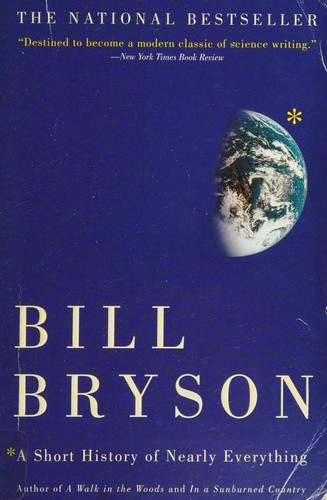
A short history of nearly everything (2004) Parents Guide: Is the book OK for kids?
Age Rating, Sex, Violence & Language
A Short History of Nearly Everything by American author Bill Bryson is a popular science book that explains some areas of science, using easily accessible language that appeals more so to the general public than many other books dedicated to the subject. It was one of the bestselling popular science books of 2005 in the United Kingdom, selling over 300,000 copies. A Short History deviates from Bryson's popular travel book genre, instead describing general sciences such as chemistry, paleontology, astronomy, and particle physics… Sign up for the full guide
Adult • 2004 • 544 pages • Lexile 1190L (high school or more advanced reading difficulty)
This is a comprehensive and engaging survey of the history of science, spanning from the Big Bang to modern microbiology. The book is suitable for curious teens and adults, earning its suggested age due to the density of information and occasional references to the grim side of history, such as the accidental deaths of scientists and the dark reality of extinctions. Parents should note that while it is an educational text, it includes… Sign up for the full guide
Is A short history of nearly everything appropriate for kids?
This is a comprehensive and engaging survey of the history of science, spanning from the Big Bang to modern microbiology. The book is suitable for curious teens and adults, earning its suggested age due to the density of information and occasional references to the grim side of… Read more — free account
Content severity in A short history of nearly everything
What happens in A short history of nearly everything, moment by moment
- p. 9 🔥 Mature Themes 2/10
- p. 35 ⚔ Violence & Gore 3/10
- p. 94 ⚔ Violence & Gore 4/10
Sex and nudity in A short history of nearly everything
This category is virtually non-existent throughout the text. Bryson focuses on scientific principles, though there are fleeting, clinical mentions of the reproductive habits of prehistoric species and microorganisms. There are brief, non-explicit references to the scandalous personal lives of a few historical scientists, such as affairs or eccentric social behavior. For instance, the book touches upon the complicated marriage and family life of Albert Einstein and the oddities of Isaac Newton. The tone remains…
Read more — free accountViolence and gore in A short history of nearly everything
Violence is moderate and contextualized within a historical or scientific framework. The book describes catastrophic natural disasters like the 1755 Lisbon earthquake and the violent forces involved in the Big Bang. It also details the mass extinction of species, including the 'Great Dying' and the impact of the asteroid that killed the dinosaurs. Several passages recount the occasionally fatal accidents that befell early researchers, such as radiation poisoning suffered by Marie Curie or the lethal results of…
Read more — free accountLanguage in A short history of nearly everything
Language is very mild and infrequent, typically occurring when Bryson quotes historical figures directly. There are a few instances of words like 'hell' or 'damn' used for emphasis in quotations or the narrative, but there is no pervasive or aggressive profanity. The text maintains the sophisticated and accessible tone of a popular science book. Younger readers will likely find the vocabulary challenging but the occasional mild exclamation is never gratuitous. The overall atmosphere is that of a learned and witty…
Read more — free accountDrugs, alcohol, and smoking in A short history of nearly everything
Substance use consists of brief mentions of scientists experimenting on themselves with dangerous gases or chemicals. Notable examples include Humphry Davy's intentional inhalation of nitrous oxide and other hazardous substances during his research. The text also covers the historical development and consequences of hazardous materials like leaded gasoline and CFCs, highlighting the poisoning of factory workers. There are minor mentions of social drinking in the context of Victorian science clubs or dinner…
Read more — free accountMature themes in A short history of nearly everything
The book explores heavy themes such as human curiosity, the staggering scale of the universe, and the extreme fragility of life on Earth. A major recurring theme is the persistence required for scientific discovery and the frequent lack of recognition for brilliant minds. Bryson emphasizes the statistical improbability of human existence, which may prompt deep existential reflection in younger readers. There is a strong focus on the environment and the irreversible nature of extinction. The text encourages a sense…
Read more — free accountFrequently Asked Questions
Is A short history of nearly everything appropriate for kids?
Bontent's parent guide suggests A short history of nearly everything is best for ages 12+. This is a comprehensive and engaging survey of the history of science, spanning from the Big Bang to modern microbiology. The book is suitable for curious teens and adults, earning its suggested age due to the density…
What age rating does A short history of nearly everything have?
Books don't carry official age ratings. A short history of nearly everything is shelved by its publisher as Adult, but that's a marketing category, not a content rating — Bontent's own review of what's actually on the page puts it at ages 12+.
What reading level is A short history of nearly everything?
A short history of nearly everything is 544 pages and its reading level is Lexile 1190L (high school or more advanced reading difficulty). Bontent recommends it for ages 12+.
What is A short history of nearly everything about?
This is a comprehensive and engaging survey of the history of science, spanning from the Big Bang to modern microbiology. The book is suitable for curious teens and adults, earning its suggested age due to the density of information and occasional references to the grim side of history, such as the accidental deaths…
Is there sex or nudity in A short history of nearly everything?
This category is virtually non-existent throughout the text. Bryson focuses on scientific principles, though there are fleeting, clinical mentions of the reproductive habits of prehistoric species and microorganisms. There are brief, non-explicit references…
How violent is A short history of nearly everything?
Violence is moderate and contextualized within a historical or scientific framework. The book describes catastrophic natural disasters like the 1755 Lisbon earthquake and the violent forces involved in the Big Bang. It also details the mass extinction of…
Is the language in A short history of nearly everything appropriate for kids?
Language is very mild and infrequent, typically occurring when Bryson quotes historical figures directly. There are a few instances of words like 'hell' or 'damn' used for emphasis in quotations or the narrative, but there is no pervasive or aggressive…
Are drugs, alcohol, or smoking depicted in A short history of nearly everything?
Substance use consists of brief mentions of scientists experimenting on themselves with dangerous gases or chemicals. Notable examples include Humphry Davy's intentional inhalation of nitrous oxide and other hazardous substances during his research. The text…
What mature themes appear in A short history of nearly everything?
The book explores heavy themes such as human curiosity, the staggering scale of the universe, and the extreme fragility of life on Earth. A major recurring theme is the persistence required for scientific discovery and the frequent lack of recognition for…
Where can I read the full A short history of nearly everything parent guide?
Create a free Bontent account to unlock page-level notes, filter by your kids' ages, and save titles to your watchlist.
Less intense books for families
Sign up to filter






More philosophy books with parent guides
- Told in letters parent guide
- The 48 Laws of Power parent guide
- The contemporary Negro novel parent guide
- A century of the English novel parent guide
- Jonathan Strange & Mr Norrell parent guide
- Homo Deus: A Brief History of Tomorrow parent guide
- Biggest Ideas in the Universe 2 parent guide
- Killers of the Flower Moon: The Osage Murders and the Birth of the FBI parent guide
- The Wager: A Tale of Shipwreck, Mutiny and Murder parent guide
- The three musketeers parent guide
- Factfulness: Ten Reasons We're Wrong About the World – and Why Things Are Better Than You Think parent guide
- Brave New World parent guide
Popular Science books parents are checking
- The Return of the Young Prince parent guide
- No mind of man parent guide
- 6 great short novels of science fiction parent guide
- Moby-Dick or, The Whale parent guide
- Into Thin Air: A Personal Account of the Mt. Everest Disaster parent guide
- No Man’s Land parent guide
- Journey to the Centre of the Earth parent guide
- An Absolutely Remarkable Thing (The Carls, #1) parent guide
More books by Bill Bryson
- The Body: A Guide for Occupants parent guide
- A Walk in the Woods parent guide
- A Walk in the Woods: Rediscovering America on the Appalachian Trail parent guide
- The Body parent guide
- The Mother Tongue parent guide
- Down Under (In a Sunburned Country) parent guide
- Neither here nor there parent guide
- I'm a stranger here myself parent guide
- The Lost Continent parent guide
More books with Bontent parent guides
- Charlie the Choo-Choo parent guide
- The Martian Contingency parent guide
- The Bookshop on Rosemary Lane parent guide
- Atomic Habits: An Easy & Proven Way to Build Good Habits & Break Bad Ones parent guide
- The Battle of the Labyrinth (Percy Jackson and the Olympians, #4) parent guide
- The ballad of the hundred days parent guide
- Before They Are Hanged (The First Law, #2) parent guide
- 2001: A Space Odyssey parent guide
- The man from up there parent guide
- The contemporary Negro novel parent guide
- Harry Potter parent guide
- 6 great short novels of science fiction parent guide
- The Institute parent guide
- Arena 13 parent guide
- The Maid: A Novel (Molly the Maid, #1) parent guide
- From Blood and Ash (Blood and Ash, #1) parent guide