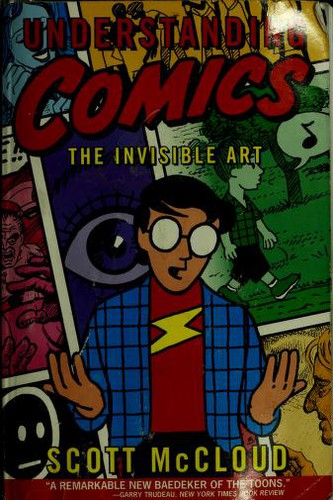
Understanding Comics (2000) Parents Guide: Is the book OK for kids?
Age Rating, Sex, Violence & Language
Praised throughout the cartoon industry by such luminaries as Art Spiegelman, Matt Groening, and Will Eisner, Scott McCloud's Understanding Comics is a seminal examination of comics art: its rich history, surprising technical components, and major cultural significance. Explore the secret world between the panels, through the lines, and within the hidden symbols of a powerful but misunderstood art form.
Upper MG • 2000 • 215 pages • Grade 7-9
This is a non-fiction seminal work analyzing the history, theory, and mechanics of the comic book medium. While the tone is academic and highly accessible, it contains brief references to the history of mature art and depictions of historical cartoon violence as examples of the form. It is best suited for older children, teens, and adults interested in art theory and storytelling rather than those seeking a traditional narrative.
Is Understanding Comics appropriate for kids?
This is a non-fiction seminal work analyzing the history, theory, and mechanics of the comic book medium. While the tone is academic and highly accessible, it contains brief references to the history of mature art and depictions of historical cartoon violence as examples of the… Continue with an account
Content severity in Understanding Comics
What happens in Understanding Comics, moment by moment
- p. 2 🔥 Mature Themes 1/10
- p. 10 ⚔ Violence & Gore 3/10
- p. 18 ♥ Sex & Nudity 2/10
Sex and nudity in Understanding Comics
Content in this category is very minimal and purely historical or analytical. McCloud discusses the evolution of art, including brief, non-explicit references to the history of erotic art and the use of the human form in woodcuts, though nothing is graphic or pornographic. In Chapter 1, there is a reference to historical prints that might include nudity in a scholarly context, but they are stylized and small. The book treats the human body as a tool for communication rather than an object of arousal. There are no…
Continue with an accountViolence and gore in Understanding Comics
Violence is limited to historical examples of cartoon tropes and a few illustrations depicting historical conflicts to explain how comics relay information. For instance, Chapter 1 features a pre-Columbian manuscript showing scenes of conquest and sacrifice in a simplified, ancient art style. Chapter 3 contains the most famous example of violence, using a theoretical murder with an axe to explain the concept of 'closure,' where the reader mentally completes the action between panels. Other instances include…
Continue with an accountLanguage in Understanding Comics
The text is almost entirely clean and maintains a professional, educational tone throughout. Because the book is an analytical and pedagogical work, it avoids profanity, vulgarity, or derogatory slurs. Chapter 4 mentions the use of symbols like 'grawlixes' (symbols like #@$%!) to represent cursing in comics without actually using the words. The vocabulary is academic and sophisticated, intended for readers who are interested in art theory and semiotics. Parents should not expect any offensive language in the…
Continue with an accountDrugs, alcohol, and smoking in Understanding Comics
There are no depictions of recreational drug use or alcohol consumption throughout this pedagogical work. As a non-fiction analysis of art theory, the book maintains a scholarly focus on the mechanics of storytelling and visual communication. The lack of substance-related content makes the title appropriate for academic environments and young students of the medium. McCloud occasionally uses metaphors involving physical senses, but never in the context of intoxication or substance abuse. The focus remains strictly…
Continue with an accountMature themes in Understanding Comics
The book deals with abstract concepts such as semiotics, the psychology of perception, and the philosophy of art. It explores how humans project themselves into inanimate objects and the cultural importance of visual storytelling. Significant chapters focus on the 'gutters' between panels and how the human mind bridges gaps in time and space. McCloud also breaks down the creative process into six distinct stages, ranging from raw idea to technical surface craft. The work encourages readers to think critically…
Continue with an accountFrequently Asked Questions
Is Understanding Comics appropriate for kids?
Bontent's parent guide suggests Understanding Comics is best for ages 12+. This is a non-fiction seminal work analyzing the history, theory, and mechanics of the comic book medium. While the tone is academic and highly accessible, it contains brief references to the history of mature art and…
What age rating does Understanding Comics have?
Books don't carry official age ratings. Understanding Comics is published for a Upper MG audience, and Bontent's independent parent guide recommends it for ages 12+.
What reading level is Understanding Comics?
Understanding Comics is 215 pages and its reading level is Grade 7-9. Bontent recommends it for ages 12+.
What is Understanding Comics about?
This is a non-fiction seminal work analyzing the history, theory, and mechanics of the comic book medium. While the tone is academic and highly accessible, it contains brief references to the history of mature art and depictions of historical cartoon violence as examples of the form. It is best suited for older…
Is there sex or nudity in Understanding Comics?
Content in this category is very minimal and purely historical or analytical. McCloud discusses the evolution of art, including brief, non-explicit references to the history of erotic art and the use of the human form in woodcuts, though nothing is graphic or…
How violent is Understanding Comics?
Violence is limited to historical examples of cartoon tropes and a few illustrations depicting historical conflicts to explain how comics relay information. For instance, Chapter 1 features a pre-Columbian manuscript showing scenes of conquest and sacrifice…
Is the language in Understanding Comics appropriate for kids?
The text is almost entirely clean and maintains a professional, educational tone throughout. Because the book is an analytical and pedagogical work, it avoids profanity, vulgarity, or derogatory slurs. Chapter 4 mentions the use of symbols like 'grawlixes'…
Are drugs, alcohol, or smoking depicted in Understanding Comics?
There are no depictions of recreational drug use or alcohol consumption throughout this pedagogical work. As a non-fiction analysis of art theory, the book maintains a scholarly focus on the mechanics of storytelling and visual communication. The lack of…
What mature themes appear in Understanding Comics?
The book deals with abstract concepts such as semiotics, the psychology of perception, and the philosophy of art. It explores how humans project themselves into inanimate objects and the cultural importance of visual storytelling. Significant chapters focus…
Where can I read the full Understanding Comics parent guide?
Create a free Bontent account to save titles and find family picks. Full page-level details use guide credits or Bontent Parent membership.
Less intense books for families
Sign up to filter




More history books with parent guides
- Essays in romantic literature parent guide
- Told in letters parent guide
- Stories from English history parent guide
- The biography of Sir Gawain in medieval French literature parent guide
- The 48 Laws of Power parent guide
- The contemporary Negro novel parent guide
- The modern novel parent guide
- A century of the English novel parent guide
- Jonathan Strange & Mr Norrell parent guide
- Homo Deus: A Brief History of Tomorrow parent guide
- Killers of the Flower Moon: The Osage Murders and the Birth of the FBI parent guide
- The Wager: A Tale of Shipwreck, Mutiny and Murder parent guide
Graphic Novel books parents are checking
- Saga, Vol. 1 parent guide
- The Complete Maus parent guide
- Maus I & II parent guide
- Hilo Book 8 parent guide
- Saga, Vol. 2 parent guide
- Persepolis: The Story of a Childhood parent guide
- Locke & Key, Vol. 1: Welcome to Lovecraft parent guide
- Steal Like an Artist: 10 Things Nobody Told You About Being Creative parent guide
- Paper Girls, Volume 1 parent guide
- Fables, Vol. 1: Legends in Exile parent guide
- ANTHEM: The Graphic Novel parent guide
- The Kind Worth Killing (Ingrid Bergman #1) parent guide
More books with Bontent parent guides
- Sunlight Finds You parent guide
- The Hobbit, or There and Back Again parent guide
- Queen of Lombard Street parent guide
- Essays in romantic literature parent guide
- Farm friends story book parent guide
- Eragon (The Inheritance Cycle, #1) parent guide
- Works (Poems / Wuthering Heights) parent guide
- The Battle of the Labyrinth (Percy Jackson and the Olympians, #4) parent guide
- The ballad of the hundred days parent guide
- The Comrade in white parent guide
- In the toils of slavery parent guide
- 2001: A Space Odyssey parent guide
- The biography of Sir Gawain in medieval French literature parent guide
- Mother in modern story parent guide
- The modern novel parent guide
- The Christmas Stories [8 stories] parent guide