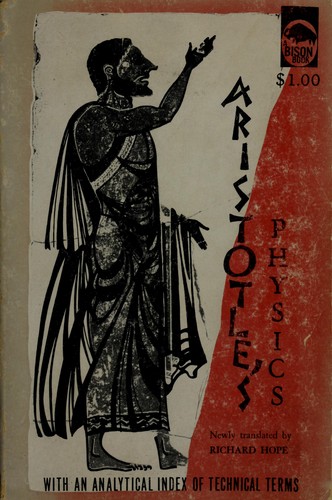
Physics (1472) Parents Guide: Is the book OK for kids?
Age Rating, Sex, Violence & Language
Part 1: Logic (Organon) Categories, translated by E. M. Edghill On Interpretation, translated by E. M. Edghill Prior Analytics (2 Books), translated by A. J. Jenkinson Posterior Analytics (2 Books), translated by G. R. G. Mure Topics (8 Books), translated by W. A. Pickard-Cambridge Sophistical Refutations, translated by W. A. Pickard-Cambridge Part 2: Universal Physics Physics (8 Books), translated by R. P. Hardie and R. K. Gaye On the Heavens (4 Books), translated by J. L. Stocks On Gerneration and Corruption (2 Books), translated… Sign up for the full guide
Adult • 1472 • 464 pages • College Level
Aristotle's Physics is a foundational work of natural philosophy that explores the concepts of time, motion, void, and causality. As a theoretical academic text, it contains no narrative fiction, graphic violence, or sexual content. The work is intended for mature students of philosophy or science and serves as a study of the principles of the physical world rather than a story. It is suitable for any age capable of handling dense… Sign up for the full guide
Is Physics appropriate for kids?
Aristotle's Physics is a foundational work of natural philosophy that explores the concepts of time, motion, void, and causality. As a theoretical academic text, it contains no narrative fiction, graphic violence, or sexual content. The work is intended for mature students of… Read more — free account
Content severity in Physics
What happens in Physics, moment by moment
- p. 1 🔥 Mature Themes 1/10
- p. 12 🔥 Mature Themes 1/10
- p. 24 🔥 Mature Themes 1/10
Sex and nudity in Physics
This category is entirely absent from the text. Aristotle's Physics is a foundational scientific and philosophical treatise that focuses exclusively on the nature of physical reality, motion, and causality. The work does not discuss human sexuality, romantic relationships, or biological reproduction in a sexual context. The tone is strictly academic and pedagogical, appropriate for students of ancient philosophy. No references to physical intimacy or gendered social dynamics are present throughout the eight books.
Violence and gore in Physics
There is no physical violence, combat, or harm directed at living beings within this work. While Aristotle frequently uses terms like 'force,' 'impact,' and 'violent motion,' these are utilized in a strictly mechanical sense to describe how one object displaces another. For instance, in Book VIII, the discussion of projectiles involves objects being thrown, but not as weapons intended to injure. The text remains an abstract inquiry into the laws of physics and the mechanics of the cosmos. Readers will find no…
Read more — free accountLanguage in Physics
The translation consists of formal philosophical and technical terminology and is completely free of profanity, modern slang, or derogatory epithets. The language is dense and intellectual, requiring a high level of concentration to follow the logical syllogisms and definitions. Aristotle uses a dry, analytical style to categorize the natural world, focusing on terms like 'substratum,' 'privation,' and 'potentiality.' There are no instances of coarse language or expletives in any standard scholarly translation of…
Read more — free accountDrugs, alcohol, and smoking in Physics
This category is entirely absent from the text. As a theoretical treatise on natural philosophy and the mechanics of the universe, there are no depictions of alcohol consumption, smoking, or drug use. The work remains strictly focused on abstract scientific and logical principles throughout its 301 pages. Aristotle does not use metaphors involving intoxication or mention the social customs of drinking common in other ancient Greek literature. The environment of the text is a sterile, intellectual exploration of…
Read more — free accountMature themes in Physics
The text explores highly abstract intellectual themes including the nature of existence, the concept of the 'Unmoved Mover,' and the properties of infinite space. Aristotle grapples with the paradoxes of Zeno, the definition of time as a measurement of change, and the necessity of a first cause. These themes require significant cognitive effort and maturity to grasp but contain no disturbing or sensitive moral content. The work transitions from basic definitions of nature in the early books to complex cosmological…
Read more — free accountFrequently Asked Questions
Is Physics appropriate for kids?
Bontent's parent guide suggests Physics is best for ages 14+. Aristotle's Physics is a foundational work of natural philosophy that explores the concepts of time, motion, void, and causality. As a theoretical academic text, it contains no narrative fiction, graphic violence, or…
What age rating does Physics have?
Books don't carry official age ratings. Physics is shelved by its publisher as Adult, but that's a marketing category, not a content rating — Bontent's own review of what's actually on the page puts it at ages 14+.
What reading level is Physics?
Physics is 464 pages and its reading level is College Level. Bontent recommends it for ages 14+.
What is Physics about?
Aristotle's Physics is a foundational work of natural philosophy that explores the concepts of time, motion, void, and causality. As a theoretical academic text, it contains no narrative fiction, graphic violence, or sexual content. The work is intended for mature students of philosophy or science and serves as a…
Is there sex or nudity in Physics?
This category is entirely absent from the text. Aristotle's Physics is a foundational scientific and philosophical treatise that focuses exclusively on the nature of physical reality, motion, and causality. The work does not discuss human sexuality, romantic…
How violent is Physics?
There is no physical violence, combat, or harm directed at living beings within this work. While Aristotle frequently uses terms like 'force,' 'impact,' and 'violent motion,' these are utilized in a strictly mechanical sense to describe how one object…
Is the language in Physics appropriate for kids?
The translation consists of formal philosophical and technical terminology and is completely free of profanity, modern slang, or derogatory epithets. The language is dense and intellectual, requiring a high level of concentration to follow the logical…
Are drugs, alcohol, or smoking depicted in Physics?
This category is entirely absent from the text. As a theoretical treatise on natural philosophy and the mechanics of the universe, there are no depictions of alcohol consumption, smoking, or drug use. The work remains strictly focused on abstract scientific…
What mature themes appear in Physics?
The text explores highly abstract intellectual themes including the nature of existence, the concept of the 'Unmoved Mover,' and the properties of infinite space. Aristotle grapples with the paradoxes of Zeno, the definition of time as a measurement of…
Where can I read the full Physics parent guide?
Create a free Bontent account to unlock page-level notes, filter by your kids' ages, and save titles to your watchlist.
More philosophy books with parent guides
- The 48 Laws of Power parent guide
- Homo Deus: A Brief History of Tomorrow parent guide
- Biggest Ideas in the Universe 2 parent guide
- Factfulness: Ten Reasons We're Wrong About the World – and Why Things Are Better Than You Think parent guide
- Brave New World parent guide
- Dune parent guide
- Everything Is Tuberculosis: The History and Persistence of Our Deadliest Infection parent guide
- Ender's Game parent guide
- Ender’s Game (Ender's Saga, #1) parent guide
- Frankenstein: The 1818 Text parent guide
- The Martian parent guide
- The Martian parent guide
Philosophy books parents are checking
- THE SUBTLE ART OF NOT GIVING A F*CK parent guide
- Four Thousand Weeks: Time Management for Mortals parent guide
- The Julius Caesar murder case parent guide
- The Obstacle Is the Way: The Timeless Art of Turning Adversity to Advantage parent guide
- Being Mortal: Medicine and What Matters in the End parent guide
- Books Do Not Have Wings parent guide
- How to do nothing: Resisting the Attention Economy parent guide
- THE CREATIVE ACT parent guide
- Le petit prince parent guide
More books by Aristotle
More books with Bontent parent guides
- Black Cake parent guide
- Nine Lives parent guide
- Crow parent guide
- Operation Bounce House parent guide
- Hana Khan Carries On parent guide
- Kingdom of Shadow and Light parent guide
- You Did Nothing Wrong parent guide
- The Midnight Girls parent guide
- The Hobbit, or There and Back Again parent guide
- Moon Witch, Spider King parent guide
- Charlie the Choo-Choo parent guide
- Ghosted: An American Story parent guide
- Unrivaled parent guide
- The Name of the Wind / The Wise Man's Fear / The Slow Regard of Silent Things (The Kingkiller Chronicle #1-2.5) parent guide
- Clash of star-kings parent guide
- Blake Crouch's Dark Matter parent guide