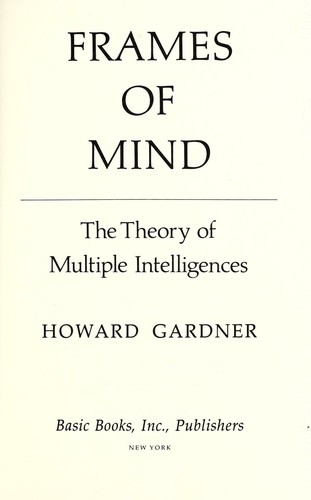
Frames of mind (1983) Parents Guide: Is the book OK for kids?
Age Rating, Sex, Violence & Language
Explores the development of the theory of multiple intelligences over the last decade.
Adult • 1983 • 440 pages • College Level
This seminal 1983 non-fiction work introduces the Theory of Multiple Intelligences, challenging the traditional view that intelligence is a single, measurable IQ. The content is academic and philosophical, suitable for educators, parents, and older students interested in psychology. There is no violence, profanity, or sexual content, making it safe for all ages, though the dense prose is intended for adult or college-level readers.
Is Frames of mind appropriate for kids?
This seminal 1983 non-fiction work introduces the Theory of Multiple Intelligences, challenging the traditional view that intelligence is a single, measurable IQ. The content is academic and philosophical, suitable for educators, parents, and older students interested in… Read more — free account
Content severity in Frames of mind
What happens in Frames of mind, moment by moment
- p. 5 🔥 Mature Themes 1/10
- p. 20 🔥 Mature Themes 2/10
- p. 45 🔥 Mature Themes 2/10
Sex and nudity in Frames of mind
This academic text contains no sexual content, romantic subplots, or anatomical discussions of a sexual nature. Howard Gardner focuses strictly on the cognitive architecture of the human mind and the history of psychological testing. There are no scenes of intimacy or mentions of reproductive health throughout the various chapters. The book maintains a purely professional and clinical tone suitable for academic study. Its absence of such material reflects its purpose as a foundational work in educational…
Read more — free accountViolence and gore in Frames of mind
There is no physical violence, gore, or aggressive behavior depicted in this non-fiction work. The text focuses on the theoretical frameworks of intelligence rather than narrative conflict or action. While Gardner mentions biological brain damage or lesions in Chapter 4 to explain how cognitive functions are localized, these are presented as medical facts rather than violent events. There are no depictions of war, crime, or intentional harm to any living beings. The book remains focused on the peaceful pursuit of…
Read more — free accountLanguage in Frames of mind
As a formal scholarly treatise, the book contains no profanity, vulgarity, or offensive slurs. Howard Gardner uses precise, high-level vocabulary appropriate for graduate-level psychology and educational research. The language is sophisticated and clinical, avoiding even mild colloquialisms or derogatory terms. Readers will encounter complex terminology like 'modularization' and 'neural lateralization' rather than any form of coarse language. It is entirely safe for all readers from a linguistic standpoint.
Drugs, alcohol, and smoking in Frames of mind
There are no references to the use, abuse, or glamorization of drugs, alcohol, or tobacco. The book does not discuss chemical substances, even in the context of brain chemistry or psychiatric medication. Gardner's focus remains on the structural and developmental aspects of the mind rather than biochemical influences. No scenes involve characters consuming alcohol or social situations where substances are present. The text is entirely focused on the cognitive and biological potential of the human intellect.
Mature themes in Frames of mind
The book explores profound themes related to human potential, the philosophy of mind, and the equity of educational systems. Gardner critiques the traditional IQ model, arguing that it unfairly marginalizes individuals with musical, athletic, or social talents. These themes involve a deep look at how society defines 'smart' and the consequences of those definitions for children. There are brief discussions of the impact of brain injury on identity and the way different cultures prioritize specific cognitive…
Read more — free accountFrequently Asked Questions
Is Frames of mind appropriate for kids?
Bontent's parent guide suggests Frames of mind is best for ages 16+. This seminal 1983 non-fiction work introduces the Theory of Multiple Intelligences, challenging the traditional view that intelligence is a single, measurable IQ. The content is academic and philosophical, suitable for…
What age rating does Frames of mind have?
Books don't carry official age ratings. Frames of mind is shelved by its publisher as Adult, but that's a marketing category, not a content rating — Bontent's own review of what's actually on the page puts it at ages 16+.
What reading level is Frames of mind?
Frames of mind is 440 pages and its reading level is College Level. Bontent recommends it for ages 16+.
What is Frames of mind about?
This seminal 1983 non-fiction work introduces the Theory of Multiple Intelligences, challenging the traditional view that intelligence is a single, measurable IQ. The content is academic and philosophical, suitable for educators, parents, and older students interested in psychology. There is no violence, profanity, or…
Is there sex or nudity in Frames of mind?
This academic text contains no sexual content, romantic subplots, or anatomical discussions of a sexual nature. Howard Gardner focuses strictly on the cognitive architecture of the human mind and the history of psychological testing. There are no scenes of…
How violent is Frames of mind?
There is no physical violence, gore, or aggressive behavior depicted in this non-fiction work. The text focuses on the theoretical frameworks of intelligence rather than narrative conflict or action. While Gardner mentions biological brain damage or lesions…
Is the language in Frames of mind appropriate for kids?
As a formal scholarly treatise, the book contains no profanity, vulgarity, or offensive slurs. Howard Gardner uses precise, high-level vocabulary appropriate for graduate-level psychology and educational research. The language is sophisticated and clinical…
Are drugs, alcohol, or smoking depicted in Frames of mind?
There are no references to the use, abuse, or glamorization of drugs, alcohol, or tobacco. The book does not discuss chemical substances, even in the context of brain chemistry or psychiatric medication. Gardner's focus remains on the structural and…
What mature themes appear in Frames of mind?
The book explores profound themes related to human potential, the philosophy of mind, and the equity of educational systems. Gardner critiques the traditional IQ model, arguing that it unfairly marginalizes individuals with musical, athletic, or social…
Where can I read the full Frames of mind parent guide?
Create a free Bontent account to unlock page-level notes, filter by your kids' ages, and save titles to your watchlist.
Psychology books parents are checking
- Atomic Habits: An Easy & Proven Way to Build Good Habits & Break Bad Ones parent guide
- Four Thousand Weeks: Time Management for Mortals parent guide
- Persepolis: The Story of a Childhood parent guide
- Cultish: The Language of Fanaticism parent guide
- Range: Why Generalists Triumph in a Specialized World parent guide
- How to Change Your Mind: The New Science of Psychedelics parent guide
- Being Mortal: Medicine and What Matters in the End parent guide
- Daring Greatly: How the Courage to Be Vulnerable Transforms the Way We Live, Love, Parent, and Lead parent guide
- Drive: The Surprising Truth About What Motivates Us parent guide
- Big Magic: Creative Living Beyond Fear parent guide
- David and Goliath: Underdogs, Misfits, and the Art of Battling Giants parent guide
- Books Do Not Have Wings parent guide
More books with Bontent parent guides
- Charged parent guide
- The Midnight Girls parent guide
- The Martian Contingency parent guide
- The Bookshop on Rosemary Lane parent guide
- Babel: Or the Necessity of Violence: An Arcane History of the Oxford Translators' Revolution parent guide
- The Battle of the Labyrinth (Percy Jackson and the Olympians, #4) parent guide
- The motion picture chums' outdoor exhibition, or, The film that solved a mystery parent guide
- The man from up there parent guide
- The contemporary Negro novel parent guide
- The Christmas Stories [8 stories] parent guide
- The Dark Tower II: The Drawing of the Three (The Dark Tower, #2) parent guide
- Onyx Storm (The Empyrean, #3) parent guide
- A century of the English novel parent guide
- Harry Potter parent guide
- 6 great short novels of science fiction parent guide
- With This Ring? parent guide