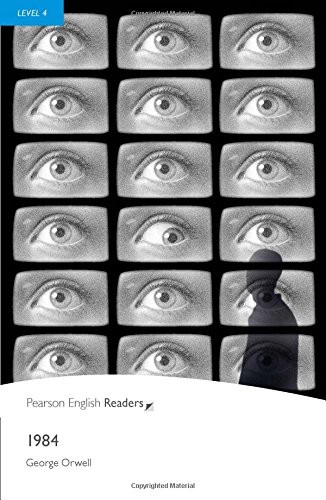
1984 (adaptation) (2008) Parents Guide: Is the book OK for kids?
Age Rating, Sex, Violence & Language
Winston Smith lives in a society where the government controls people every second of the day. He fights this world with love. But it's dangerous: love for another person can be punished by death - and Big Brother is always watching. Orwell's classic story shows that there is no freedom unless ideas and beliefs can be questioned. This is as true today as when it was written, more than fifty years ago. --back cover
Upper MG • 2008 • 72 pages • CEFR B2 / Lexile 720L (roughly grades 2–3 reading difficulty)
This is a simplified retelling of George Orwell's classic dystopian novel, designed for English language learners and readers with lower literacy levels. While the language is accessible, the book retains the dark themes of a totalitarian state, government surveillance, and physiological torture. It is suitable for teenagers and adults who need an entry point to the story's heavy concepts of political oppression and psychological… Sign up for the full guide
Is 1984 (adaptation) appropriate for kids?
This is a simplified retelling of George Orwell's classic dystopian novel, designed for English language learners and readers with lower literacy levels. While the language is accessible, the book retains the dark themes of a totalitarian state, government surveillance, and… Read more — free account
Content severity in 1984 (adaptation)
What happens in 1984 (adaptation), moment by moment
- p. 5 🔥 Mature Themes 3/10
- p. 8 🍷 Substances 2/10
- p. 10 🔥 Mature Themes 2/10
Sex and nudity in 1984 (adaptation)
The romance between Winston and Julia is central to the plot as an act of rebellion, but it is handled with restraint in this adaptation. Physical intimacy is mentioned as a concept of defiance rather than described in detail, focusing more on their emotional connection and the risk they take by meeting. The Party's stance against sexual pleasure is explained as a way to divert energy toward state worship. Winston recalls his joyless marriage to Katherine, who viewed the act only as a duty to the Party. While the…
Read more — free accountViolence and gore in 1984 (adaptation)
The second half of the book includes the threat of execution and the psychological and physical torture of the protagonist. A significant scene involves the threat of rats being used to attack a character's face in the dreaded Room 101. Before this, Winston is subjected to repeated beatings by guards and agonizing electrical shocks administered by O'Brien. The violence is portrayed as a tool for brainwashing rather than for shock value. Even the 'Two Minutes Hate' early in the book depicts a collective…
Read more — free accountLanguage in 1984 (adaptation)
Language is very mild in this version of the story. As a 'High-Interest, Low-Vocabulary' reader, the language is simplified and avoids profanity or complex jargon that might confuse the reader. The most significant 'language' element is the concept of Newspeak, where the Party removes words like 'bad' and replaces them with 'ungood.' This serves as a thematic exploration of how vocabulary shapes our ability to think. Readers will not encounter vulgarity, though the tone remains consistently grim and oppressive…
Read more — free accountDrugs, alcohol, and smoking in 1984 (adaptation)
Characters drink 'Victory Gin,' which is described as tasting like oil or medicine, used by the state to dull the senses of the population. Winston uses it to steady his nerves before committing the illegal act of writing in his diary. In addition to gin, the characters smoke 'Victory Cigarettes,' which are of poor quality and prone to falling apart. These substances are not portrayed as enjoyable, but rather as low-quality rations provided by a failing economy. There is no mention of illegal narcotics or…
Read more — free accountMature themes in 1984 (adaptation)
This adaptation maintains a heavy focus on the loss of privacy, the rewriting of history, thought control, and the betrayal of loved ones under extreme duress. Winston Smith’s job at the Ministry of Truth involves literally changing past records to match current government lies. The presence of the 'Thought Police' creates a constant atmosphere of paranoia where children are encouraged to spy on their parents. The ultimate theme is the destruction of the individual spirit and the terrifying power of a state that…
Read more — free accountFrequently Asked Questions
Is 1984 (adaptation) appropriate for kids?
Bontent's parent guide suggests 1984 (adaptation) is best for ages 12+. This is a simplified retelling of George Orwell's classic dystopian novel, designed for English language learners and readers with lower literacy levels. While the language is accessible, the book retains the dark…
What age rating does 1984 (adaptation) have?
Books don't carry official age ratings. 1984 (adaptation) is published for a Upper MG audience, and Bontent's independent parent guide recommends it for ages 12+.
What reading level is 1984 (adaptation)?
1984 (adaptation) is 72 pages and its reading level is CEFR B2 / Lexile 720L (roughly grades 2–3 reading difficulty). Bontent recommends it for ages 12+.
What is 1984 (adaptation) about?
This is a simplified retelling of George Orwell's classic dystopian novel, designed for English language learners and readers with lower literacy levels. While the language is accessible, the book retains the dark themes of a totalitarian state, government surveillance, and physiological torture. It is suitable for…
Is there sex or nudity in 1984 (adaptation)?
The romance between Winston and Julia is central to the plot as an act of rebellion, but it is handled with restraint in this adaptation. Physical intimacy is mentioned as a concept of defiance rather than described in detail, focusing more on their emotional…
How violent is 1984 (adaptation)?
The second half of the book includes the threat of execution and the psychological and physical torture of the protagonist. A significant scene involves the threat of rats being used to attack a character's face in the dreaded Room 101. Before this, Winston…
Is the language in 1984 (adaptation) appropriate for kids?
Language is very mild in this version of the story. As a 'High-Interest, Low-Vocabulary' reader, the language is simplified and avoids profanity or complex jargon that might confuse the reader. The most significant 'language' element is the concept of…
Are drugs, alcohol, or smoking depicted in 1984 (adaptation)?
Characters drink 'Victory Gin,' which is described as tasting like oil or medicine, used by the state to dull the senses of the population. Winston uses it to steady his nerves before committing the illegal act of writing in his diary. In addition to gin, the…
What mature themes appear in 1984 (adaptation)?
This adaptation maintains a heavy focus on the loss of privacy, the rewriting of history, thought control, and the betrayal of loved ones under extreme duress. Winston Smith’s job at the Ministry of Truth involves literally changing past records to match…
Where can I read the full 1984 (adaptation) parent guide?
Create a free Bontent account to unlock page-level notes, filter by your kids' ages, and save titles to your watchlist.
Less intense books for families
Sign up to filter




More sci-fi books with parent guides
- Sunrise on the Reaping parent guide
- Operation Bounce House parent guide
- The Martian Contingency parent guide
- A Boy and His Dog parent guide
- The House in the Cerulean Sea (Cerulean Chronicles, #1) parent guide
- A Hole in the Sky parent guide
- Before They Are Hanged (The First Law, #2) parent guide
- No mind of man parent guide
- The man from up there parent guide
- 6 great short novels of science fiction parent guide
- Saga, Vol. 1 parent guide
- The Time of Contempt (The Witcher, #2) parent guide
Dystopian books parents are checking
- Crow parent guide
- Wuthering Heights, Agnes Grey, and Poems parent guide
- The ballad of the hundred days parent guide
- The Ballad of Songbirds and Snakes (The Hunger Games, #0) parent guide
- Death's End (Remembrance of Earth's Past, #3) parent guide
- Tender is the Flesh parent guide
- Steelheart (The Reckoners, #1) parent guide
- I Who Have Never Known Men parent guide
- Anna Karenina parent guide
More books by Michael Dean
More books with Bontent parent guides
- Tall Oaks parent guide
- Charged parent guide
- The Name of the Wind / The Wise Man's Fear / The Slow Regard of Silent Things (The Kingkiller Chronicle #1-2.5) parent guide
- The Martian Contingency parent guide
- Clash of star-kings parent guide
- Blake Crouch's Dark Matter parent guide
- Atomic Habits: An Easy & Proven Way to Build Good Habits & Break Bad Ones parent guide
- The motion picture chums' outdoor exhibition, or, The film that solved a mystery parent guide
- Before They Are Hanged (The First Law, #2) parent guide
- The man from up there parent guide
- Blood of Elves (The Witcher, #1) parent guide
- Onyx Storm (The Empyrean, #3) parent guide
- A century of the English novel parent guide
- The complete works of the Gawain-poet parent guide
- The Maid: A Novel (Molly the Maid, #1) parent guide
- Biggest Ideas in the Universe 2 parent guide